Election debates have something of a theatrical performance. Two candidates, several aides who have spent weeks preparing every phrase, and a collection of arguments carefully arranged so that nothing is left to chance. Spontaneity, when it appears, is usually an accident that campaign teams try at all costs to avoid.
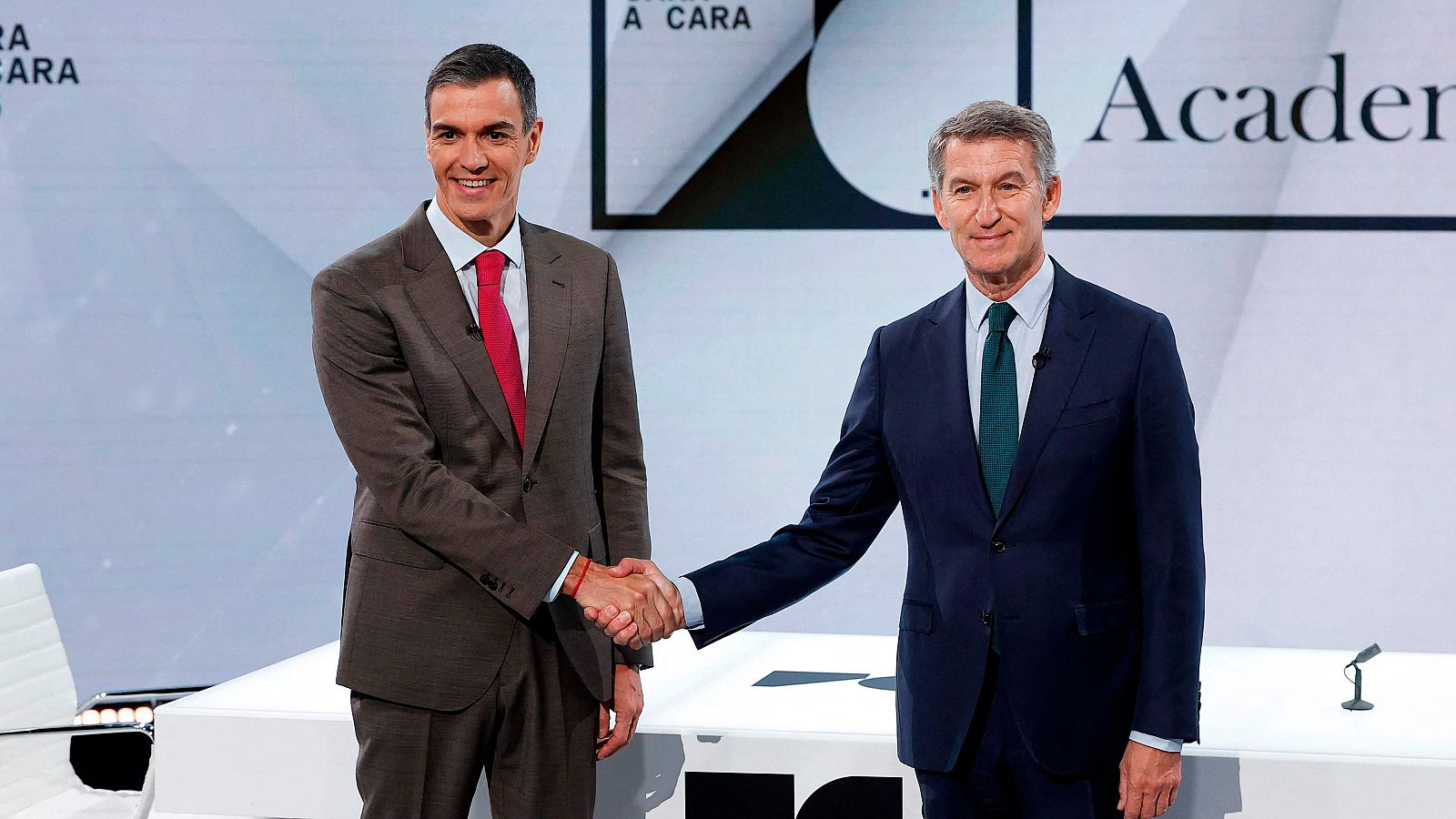
The face-to-face between Pedro Sánchez and Alberto Núñez Feijóo was no exception. Both arrived with prepared speeches, their figures and rehearsed attacks. The difference lay in the fact that one managed to execute his strategy better, while the other seemed determined to end a monologue that his opponent was not willing to listen to in silence.
And there, in my view, Feijóo won by a clear margin.
Maria Casado and the merit of knowing how to disappear
Before entering the political confrontation, it is worth recognizing María Casado’s work. In my opinion, her moderation was exemplary: impartial, professional, and sufficiently firm to maintain order without claiming a protagonistic role that did not belong to her.
Seems obvious, but anyone who regularly follows political television knows it doesn’t always happen. There are moderators who seem to approach debates convinced that they are the real protagonists and that the candidates constitute an annoying interruption to their program.
Casado avoided that error. She intervened as needed, let them discuss, and allowed each candidate to present themselves in their own words. In a political debate, knowing when to stay silent is also a demonstration of talent.
And it is appreciated.
Two monologues and a fundamental difference
It would be unfair to say that Sánchez went there to deliver a speech while Feijóo tried to sustain a spontaneous conversation. Both had their interventions perfectly studied. No one goes to a head-to-head of this importance with four ideas scribbled on a napkin.
However, there was a strategic difference.
Sánchez tried to develop his line of argument from start to finish, repeatedly insisting on being allowed to finish. Feijóo, aware that letting the president speak without too many interruptions could turn into a succession of small televised rallies, chose to break his rhythm.
It is not necessarily an elegant strategy, but it can be effective. And it was.
Moreover, debates no longer end when the cameras go off. They continue for days on social media, turning into thirty-second clips where each candidate says exactly what their team needs to disseminate. A good video cut can end up having more reach than twenty minutes of argument.
Feijóo seemed to understand that dimension of the confrontation. Sánchez too, of course, but he failed to impose his usual dynamic.
The result was a president more uncomfortable than usual, too focused on reclaiming the floor and less agile when he had to abandon the prepared speech.
A President on the Defensive
Feijóo had a clear advantage: he could attack the management of a government worn down by political controversies, corruption cases that have affected his circle, and the accumulated difficulties of the term.
Sánchez needed to defend himself without appearing to be constantly defending himself. A task far harder than it might seem.
He tried to steer the debate onto economic ground, to claim Spain’s growth relative to other European countries, and to lean on his international policy.
And there, Feijóo was right to question the gap between the big indicators and everyday reality.
The popular leader did not stage an extraordinary spectacle of oratory, but he did show preparation, lucidity, and confidence. He knew how to exploit the government’s weaknesses and convey a sense of control.
Sánchez, on the contrary, offered a surprisingly clumsy version for someone who has repeatedly demonstrated a great ability to cope with adverse situations.
He did not seem comfortable. And it showed.
Winning a debate does not mean winning an election
If I were on Feijóo’s team, I would not seek another head-to-head. He has come out strengthened and does not need to offer Sánchez a second chance to correct his mistakes.
There is also the four-way debate on November 26, a format in which the president is likely to feel more at ease. Sánchez is an experienced politician, with a resilience that his opponents have underestimated too many times.
It would be absurd to declare him electorally defeated because of a bad television night.
But there is no need to pretend the debate ended in a draw out of some kind of institutional courtesy.
Feijóo was Better. He took advantage of the circumstances, he managed to unsettle Sánchez, and he managed to convey greater authority. The president, instead, seemed too focused on developing his argument and too unprepared for his opponent to dismantle it.
Both entered with a script. Both tried to deliver their monologue.
The difference is that Feijóo understood that, to win that debate, it wasn’t enough to recite his own well: he also had to prevent Sánchez from calmly reciting his own.
And Sánchez, who has so often known how to turn politics into a stage tailored to him, discovered that night that the other lead had also read the script.