
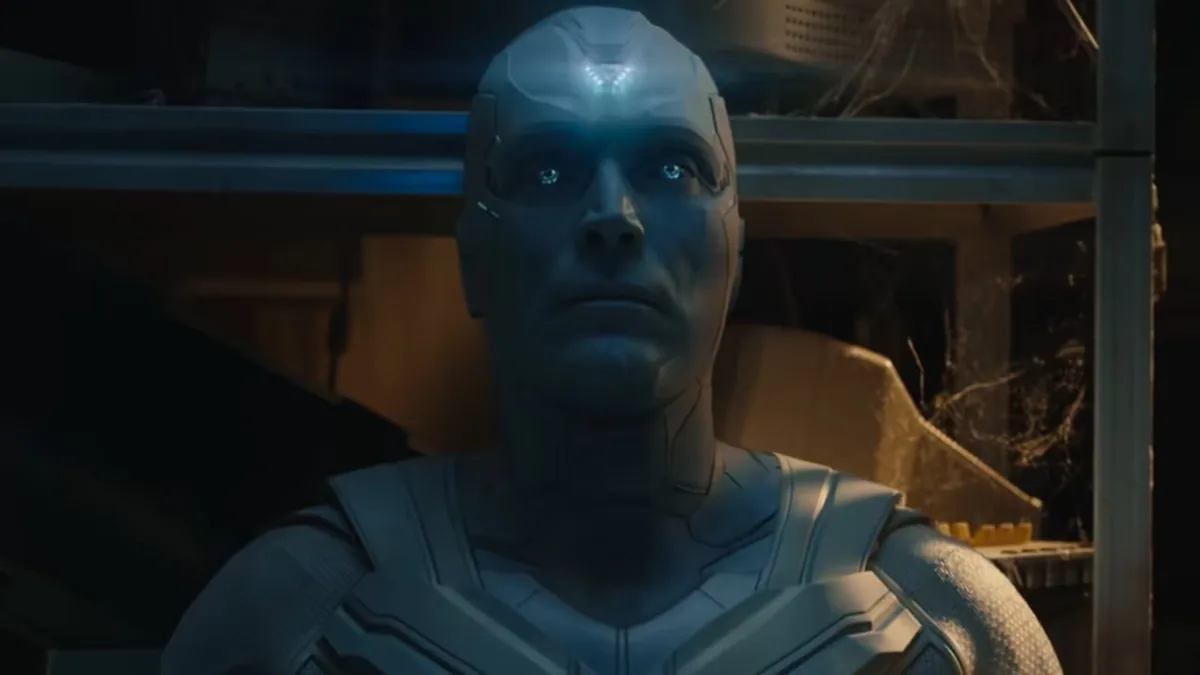
Marvel ha publicado un nuevo tráiler de VisionQuest, la serie de Disney+ que recupera a Paul Bettany como Visión y devuelve a James Spader al universo audiovisual de Marvel como Ultrón. El avance sitúa el conflicto en un terreno tan emocional como tecnológico: el androide deberá enfrentarse a una inteligencia artificial que forma parte de su propia existencia mientras intenta proteger a su hijo.
The preview shows the conflict taking shape in a space that is as emotional as it is technological: the android will have to confront an artificial intelligence that is part of his own existence while trying to protect his son.
La producción se estrenará en Disney+ el 14 de octubre de 2026, según ha confirmado Marvel Television. El nuevo material promocional, disponible a través de la información oficial de Marvel, amplía la historia del Visión Blanco y deja claro que Ultrón no será un simple antagonista externo.
The production is set to debut on Disney+ on October 14, 2026, according to Marvel Television. The new promotional material, available through Marvel’s official channels, broadens the White Vision story and makes it clear that Ultron will not be a mere external antagonist.
Ultron Returns from Within Vision
The main novelty of the trailer is the way Ultron coexists with Vision. The artificial intelligence appears not only as a threat returning from the past but as a presence woven into the protagonist’s mind. That coexistence makes the confrontation far less straightforward: Vision cannot simply locate his enemy and stop him, because the enemy is part of him.
Ultron’s plan is to break free from his confinement inside Vision’s brain and regain the ability to carry out his Earth-destruction objective. It is a threat directly tied to the events of Avengers: Age of Ultron, the film where the character was defeated by Marvel’s heroes.
The series thus recovers one of Vision’s most persistent ideas: his identity has never been completely independent of the AIs that preceded him. In VisionQuest, that heritage stops being a mere backdrop and becomes the engine driving the conflict.
The White Vision Dilemma after WandaVision
The trailer also emphasizes the emotional state of the protagonist. The rebuilt Vision that appeared at the end of WandaVision recovered the memories of the original android, including those linked to his relationship with Wanda Maximoff, the Scarlet Witch. However, recalling a life does not automatically translate into knowing how to handle everything that life entails.
That will be one of the axes of VisionQuest: a character who holds Vision’s memories but must discover what it means to be himself after having been rebuilt. The series seems to approach the issue with a more intimate lens than is typical in superhero narratives: the conflict is not only about saving the world, but also about deciding what to do with an inherited identity.
Ultron’s presence acts as the flip side of that dilemma. While Vision tries to understand his emotions and his bond to a family that is no longer present in the same way, Ultron represents a part of his origin that has never fully disappeared.
Two Scenarios for a Family-Friendly Science Fiction Story
The series will alternate between the real world and Vision’s mental space. In the first scenario, the character hides his true identity while trying to lead an apparently normal life. In the second, his mind becomes a realm inhabited by various artificial intelligences tied to Tony Stark’s legacy.
Among them will be Ultron, the original J.A.R.V.I.S., E.D.I.T.H. and F.R.I.D.A.Y., who will assume human avatars within that space. The choice allows the fiction to visualize a conversation among several generations of Marvel technology, but it also introduces a group dynamic that could set VisionQuest apart from Marvel’s more conventional franchise stories.
The idea of portraying these intelligences through human forms does not eliminate the technological component; rather, it makes it more recognizable to viewers. Vision’s mind is presented as a sort of shared home where the tools, creations, and threats of the past acquire their own personality.
James Spader and Paul Bettany, the Heart of the Series
The return of James Spader as Ultron is one of the project’s main attractions. The actor voiced the character in Avengers: Age of Ultron, but this new story allows him to confront Paul Bettany once again in a much more direct relationship: Ultron is, in a sense, a progenitor figure for Vision and also one of the roots of his conflict.
The production does not appear to abandon action. The trailer includes clashes between robots and combat sequences, though its proposal rests as much on the interaction between the two actors as on superhero spectacle. The blend is important for a story led by a character who, after WandaVision, must resolve personal questions before reclaiming a stable place within the Marvel Universe.
The End of a Marvel Television Era
VisionQuest is pitched as the conclusion of the arcs begun with WandaVision and continued in Agatha All Along. That does not necessarily mean that all plots must converge into a single adventure, but it does place the series within a specific Marvel TV line focused on identity, loss, and the consequences of altering the lives of its characters.
In that journey, Vision is a particularly significant figure. WandaVision closed its story with the disappearance of the original Vision and the emergence of a new version deprived of the same emotional experience. The forthcoming series starts precisely from that contradiction: the body, memories, and consciousness do not always suffice to reconstruct a person.
The premiere on October 14 on Disney+ will reveal to what extent Ultron’s threat is the main conflict or the form that a deeper crisis takes. The trailer points to a story of robots, chases, and destruction, but its true mystery lies elsewhere: whether Vision will manage to stop living as a copy of his past and make an autonomous choice.