
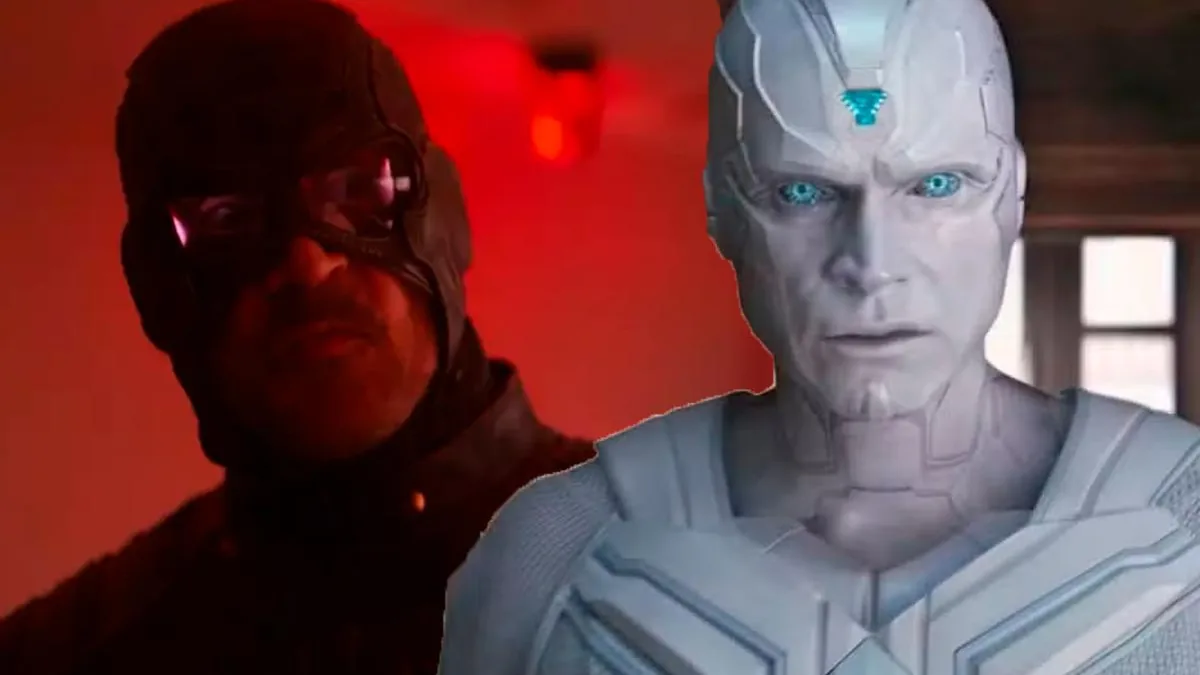
VisionQuest has posed its first major mystery around a figure that isn’t even visible: the Client who hired Paladin to locate Vision. The first two episodes lay out the assignment and its consequences, but they have not yet revealed who is behind the operation or what they intend to achieve with the android.
The question matters because Paladin functions as the immediate adversary, while the Client represents a broader threat. To try to solve the enigma it’s useful to separate what the series has already shown from clues drawn from the comics, from promotional material, or from earlier connections within the Marvel Cinematic Universe.
What’s confirmed after the first two episodes
The most solid information is also the most limited: someone with ample resources has put a price on locating Vision and has chosen Paladin to do the job. The series has not yet identified the client, explained its relationship to the protagonist, nor clarified whether the aim is to capture him, recover his body, or seize the technology that keeps him active.
That detail changes how theories can be read. It isn’t enough to find a character who has a reason to care about Vision; it must also fit with the use of a mercenary, with the secrecy of the assignment, and with the ability to operate without appearing directly on screen.
The on-screen clues weigh more than external nods
The appearance of Madripoor in the promotional materials for VisionQuest ties the series to one of the MCU’s clandestine power centers. It also invites considering Sharon Carter, whose role as an intermediary in that environment was revealed in Falcon and the Winter Soldier.
However, for now that relationship sits in the realm of inference. Madripoor could be the setting for a criminal plot without Sharon’s involvement, and the series would need to show a concrete link between her and the assignment to turn the geographic coincidence into a real clue.
The detail that would strengthen this hypothesis would be a direct reference to the sale of technology, to a network of intermediaries, or to an operation tied to Vision’s extraordinary resources. By contrast, it would lose force if the plot depicts Madripoor as merely a waypoint or if the Client is shown pursuing a personal goal unrelated to the underground market.
Which theories depend on the MCU’s past
The most direct antecedent points to S.W.O.R.D., the organization that rebuilt and reactivated the White Vision body. From that perspective, the android could be seen as an asset that eluded the control of those who created or recovered it.
The upside of this possibility is that it doesn’t require introducing a new relationship: the link between S.W.O.R.D. and Vision is already part of Marvel’s continuity. Its main problem is the lack of a visible connection to Paladin. That the agency has reasons to seek him does not prove that it ordered this particular pursuit.
A scene showing recovery documents, former S.W.O.R.D. officials, or a covert institutional operation would be the clearest confirmation. Conversely, if the Client operates from a completely private structure and seeks to negotiate with Vision, the agency’s explanation would lose weight.
The familiar lead: the link to Billy Maximoff
Another reading stems from Wanda Maximoff’s family history. After the events of Agatha, Who Else?, Billy learns her identity and maintains a link to the pursuit of his brother Tommy. In that context, locating Vision as well could answer a longing to rebuild his family.
It’s a theory with clear emotional charge, but it clashes with the method chosen. Hiring Paladin, a mercenary tied to a violent chase, doesn’t seem like the natural route for someone who would want to reunite with his father. The hypothesis would gain traction only if the series revealed that Billy does not control the assignment, that someone acts on his behalf, or that there is a threat forcing him to resort to extreme measures.
A conversation linking the Client to Tommy, Wanda, or the Westview events would be a much stronger signal than any familial parallel. If, however, the assignment is tied to a business or military operation, Billy’s candidacy would be practically ruled out.
Jocasta and the tech theory
Jocasta appears among the characters associated with the series, and her relation to Ultron in the comics makes her a particularly intriguing piece for a story focused on an android. That connection opens the door to a plot about artificial intelligence, consciousness, and the technological legacy surrounding Vision.
But one must distinguish between being announced for the series and occupying the Client’s role. Marvel may use Jocasta as an ally, rival, creation, or connecting element to another storyline. Her presence does not by itself confirm that she controls Paladin.
The decisive proof would be for Jocasta to appear tied to a network of systems, to Ultron’s remnants, or to a search related to Vision’s architecture. If her role develops as a counterpoint or collaborator to the protagonist, this theory could survive as a thematic connection, but not as the Client’s identity.
The key will be knowing what the Client wants
The four possibilities do not rest on the same kind of clue. S.W.O.R.D. has the most concrete institutional precedent; Sharon depends mostly on Madripoor’s context; Billy offers a familial motivation that still doesn’t fit with the violence of the assignment; and Jocasta rests on her connection to technology and on her announced presence.
That’s why the next important data point might not be the Client’s face. It would be enough for the series to clarify what Vision is being sought: his body, his abilities, a specific piece of information, or a personal meeting. Each objective would considerably narrow the number of candidates.
Until that revelation arrives, the most reliable clue will remain Paladin’s own assignment, not the comics’ inherited connections. VisionQuest may be using those antecedentes to steer the audience toward several possible answers, but it has not yet turned any theory into a confirmation.