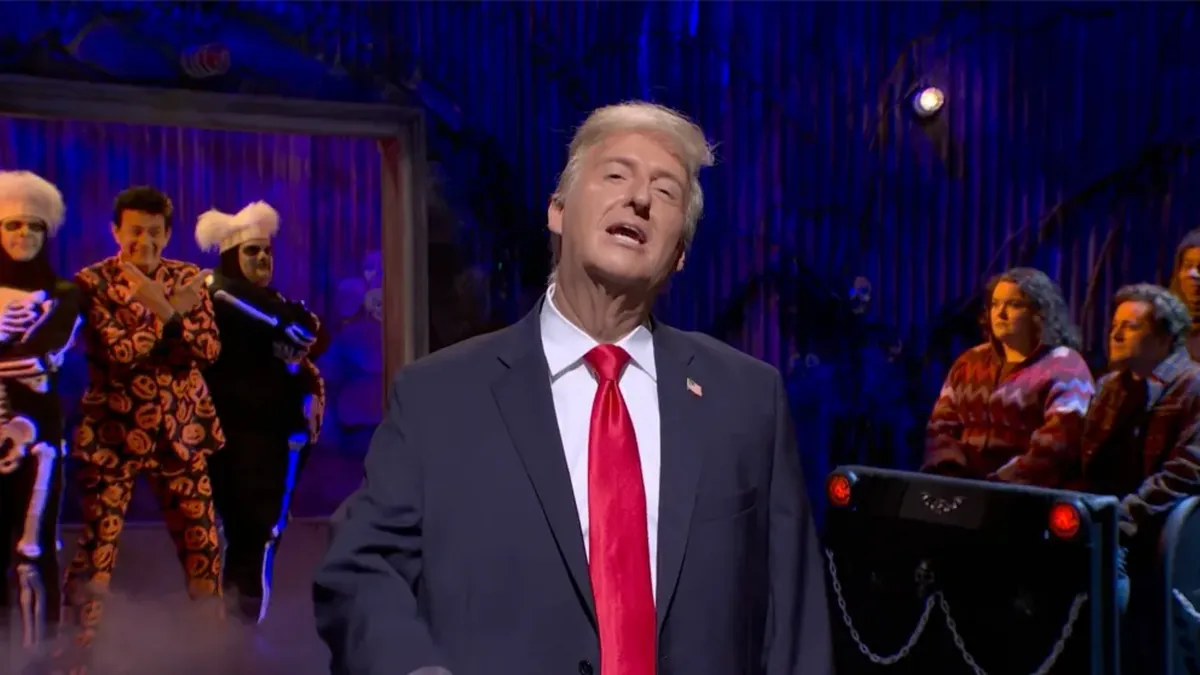
David S. Pumpkins returned to Saturday Night Live, but this time not to replay unchanged the sketch that made him an Halloween phenomenon. Tom Hanks revived the character during the October 31, 2026 broadcast, and, just as the scene seemed poised to reproduce its usual formula, the intervention of Donald Trump, played by James Austin Johnson, steered it toward political satire.
The maneuver was the most significant element of the comeback.
The comeback doesn’t repeat the 2016 joke exactly
David S. Pumpkins was born in 2016 as a deliberately disorienting idea. A man dressed in a pumpkin-covered suit appeared in a haunted attraction accompanied by two skeletal dancers, with no convincing explanation about his presence or his significance.
The humor depended precisely on that lack of sense. Visitors expected to encounter a Halloween-worthy threat and instead got a persistent, loud character who was oddly proud of being who he was. Hanks portrayed that absurd confidence without trying to turn Pumpkins into a more conventional character.
Ten years later, the new appearance builds on that accumulated recognition, but changes its function within the show. Instead of prolonging the bewilderment throughout the whole bit, the very structure of the sketch cuts the homage before it becomes an automatic repetition.
A brief chronology of a character turned into tradition
The television history of David S. Pumpkins is short, though recognizable enough to give his return a nostalgic component. Its arc can be summarized as follows:
- 2016: debuted on Saturday Night Live during a Halloween sketch starring Tom Hanks, Mikey Day and Bobby Moynihan.
- 2017: the character returned in an animated special, with Hanks again voicing him.
- 2022: reappeared in live action during a broadcast hosted by Jack Harlow.
- 2026: reappeared in the show’s Halloween opening, coinciding with the ten-year anniversary of his creation.
The sequence confirms that Pumpkins is not a weekly recurring character nor a regularly integrated figure on the series. His presence depends on a very specific occasion: Halloween and the possibility of reviving an image that the audience recognizes instantly.
Trump’s interruption is the real twist
In his earlier appearances, the joke was built around the reaction of those who did not understand what David S. Pumpkins was doing in a haunted attraction. The 2026 version preserves that premise, but uses it as a kind of prologue for another type of humor.
James Austin Johnson enters in character as Donald Trump and notes that the audience already understands how the bit unfolds: Pumpkins would keep appearing, bewildering visitors and repeating his introduction. With that gesture, SNL acknowledges the mechanics of the sketch and decides to skip them.
The joke is not merely that Trump interrupts Hanks. It also plays with the similarities the show establishes between the two characters: both burst onto popular culture in 2016, both are associated with an orange visual presence, and both are presented as figures hard to ignore.
The comparison is satirical, not a narrative equivalence between the fictional character and the politician. Its usefulness lies in condensing into a single image two elements that the show considers recognizable to its audience: the absurd Halloween icon and the political figure who dominates much of its current-events openings.
From nostalgia to the midterm elections
The tonal shift also reflects the moment the show aired. The opening arrived on the final weekend before the United States’ midterm elections scheduled for November 3, so the satire quickly left Halloween territory to enter the realm of political campaigning.
Johnson’s appearance included references to the Republicans’ prospects, Texas’s political situation, and Trump’s recent comments about the physical appearance of some men. The appearance of an impersonation of Nicki Minaj further broadened the joke toward the relationship between celebrities, political support, and the MAGA movement.
That context explains why Hanks’s return isn’t framed as a simple anniversary bit. On Saturday Night Live, the opening is typically the space where the show sets its reading of the week’s current events. Even a character created for an absurd gag can be subordinated to that priority.
What Hanks adds to the comedic device
Tom Hanks’s participation serves a function distinct from that of political impersonators. His presence triggers memories of the original sketch and offers the audience a promise of familiarity: the suit, the skeletons, and the choreography remain.
However, the actor does not need to sustain the entire scene. For much of the political portion, Hanks and his companions stay in the background, nearly becoming a frozen image of the past as the show discusses the present.
That is the main difference from earlier appearances. David S. Pumpkins ceases to be the outright center of the joke and becomes a visual icon that SNL can activate, interrupt, and reposition as the needs of the broadcast dictate. The character remains recognizable, but the show no longer relies on repeating his bewilderment for several minutes.
A Halloween character with a more flexible life
The comeback occurred in the fourth episode of season 52, hosted by Inde Navarrette and with Gracie Abrams as musical guest. It also marked Pumpkins’ third live-action appearance in a sketch, though the character had previously enjoyed an animated version.
The difference in formats helps explain its trajectory. In animation, the idea could expand into its own special; in live action, its appeal still depends on Hanks’s presence, the skeletons, and other characters’ bewildered reactions. The 2026 broadcast adds a third option: using it as a springboard for political commentary.
That is why the reach of this return is less about heralding a new chapter for David S. Pumpkins and more about showing that the character still holds value within Saturday Night Live‘s grammar. Ten years after his debut, he can appear as a tribute, as a self-referential joke, and as a visual contrast to a Donald Trump parody.
Hanks ultimately reclaimed control of the scene to give way to the show, but the number had already made its bet clear. Nostalgia was used to draw in the audience; the political interruption served to remind that on SNL no classic character stays entirely outside of current events.