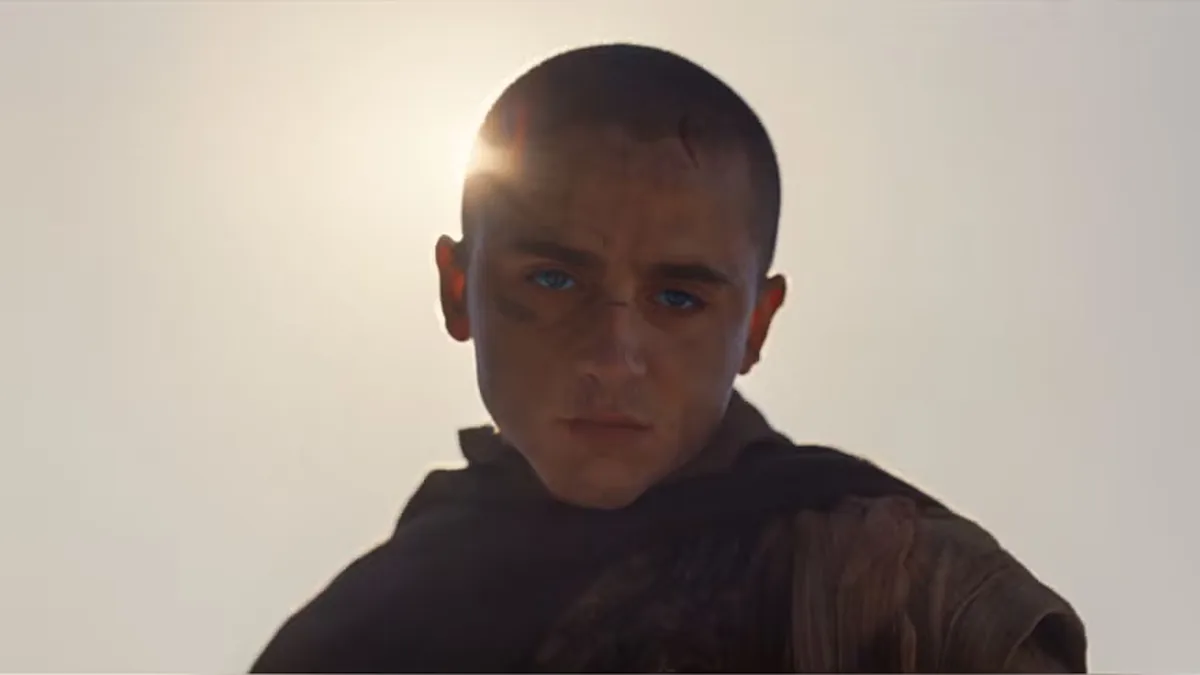
‘Dune: Part Three’ Has a New Trailer and the image that dominates the preview is the clash between Scytale, played by Robert Pattinson, and Paul Atreides, portrayed by Timothée Chalamet. The promotional material reinforces the film’s warlike dimension, but it also points to a more intimate conflict: Paul’s power begins to fray as the resistance against his empire grows.
The film will hit theaters on December 18, 2026, with Denis Villeneuve at the helm once again. The third installment will close the journey started with Dune and continued with Dune: Part Two, although its story will no longer directly follow Frank Herbert’s original novel, but rather draw from Dune Messiah, the saga’s second book.
Scytale Becomes a Direct Threat to Paul
The trailer introduces Robert Pattinson as one of the major additions to this new phase. His character, Scytale, does not appear as just another opponent within Arrakis’s political machinery: the trailer positions him as a figure capable of challenging the emperor himself and moving perilously close to his inner circle.
In Herbert’s novel, Scytale is tied to the Tleilaxu, a society known for its biological experiments, manipulation techniques, and its ability to bend the rules of power. The film has not yet explained how deeply it will develop that backstory, but the character’s presence suggests the conflict will not be resolved solely with armies, family alliances, or battles for control of the spice.
The new trailer also emphasizes a core idea for understanding this third film: Paul is no longer fighting merely to survive, but to preserve an empire born of violence. His rise to power has come at a tremendous cost, and the consequences of his decisions begin to return as rebellions.
Paul’s Reign Enters Its Most Dangerous Phase
Paul’s transformation is one of the central threads of Dune: Part Three. In the two previous films, Paul evolved from the heir of a noble house into the leader of the Fremen and a messianic figure. Now the new promotional material shows him in a very different light: a ruler who fears assassination and who answers his enemies with increasing ruthlessness.
That nuance sets the upcoming movie apart from a mere epic continuation. The story seems less about who will win the next battle and more about what remains of the young man who arrived on Arrakis before power and prophecy reshaped him. The trailer presents a more isolated Paul, surrounded by threats and compelled to live with the consequence of having turned a rebellion into an empire.
Scytale’s appearance serves precisely as a counterpoint to that evolution. In front of Paul’s visible authority, Pattinson’s character represents a danger more difficult to control: a threat that can operate through infiltration, strategy, and deception.
Chani and the Return of Familiar Characters
Zendaya returns as Chani, one of the saga’s most important figures and one of the characters who has changed the most from the original novel. The trailer again places her beside Paul, though their relationship is marked by the distance caused by the emperor’s decisions.
The film also brings back a sizable portion of the cast from the previous installments, including Florence Pugh as Princess Irulan, Anya Taylor-Joy, Rebecca Ferguson, Josh Brolin, Javier Bardem, and Charlotte Rampling. The presence of these characters ties the new film to the family, religious, and political struggles that have defined Villeneuve’s adaptation.
One of the most striking returns is Jason Momoa. The actor does not return exactly as Duncan Idaho, but as Hayt, a ghola created from Duncan’s identity. This difference matters because it introduces one of the universe’s most peculiar and intricate ideas: the possibility of reviving a familiar body without reconstituting the person who once inhabited it.
Time to time a YouTube trailer appears centered in the article, hinting at additional scenes and moments to come.
The Time Jump Changes the Rules of the Saga
The transition from Dune: Part Two to Dune: Part Three does not function as an immediate bridge. The story of Dune Messiah unfolds after Paul’s conquest and takes place in a setting where the protagonist has ceased to be merely a throne aspirant. This evolution allows the film to explore the weariness of a power that, at first, seemed impossible to challenge.
It also changes the epic’s nature. The earlier installments built their spectacle around the desert, the sandworms, the battles between houses, and Paul’s arrival into the Fremen culture. This time, the conflict appears more focused on palace intrigues, conspiracies, and the tension between the emperor’s public image and the real fragility of his position.
That does not mean Villeneuve will abandon the saga’s grand visual scale. The new trailer features large-scale confrontations, desert landscapes, and a monumental staging, but the spectacle is tied to a darker story. Paul’s power extends across the known universe while his inner circle grows increasingly smaller.
Villeneuve’s Final Film on Arrakis
Denis Villeneuve has framed this third film as the conclusion of his cinematic journey through Herbert’s universe. The director has turned the adaptation into one of the decade’s major science-fiction productions, with a clearly defined visual and sonic identity and a commitment to telling the story as a grand cinematic spectacle.
The intrigue of this installment does not rely solely on seeing how the struggle for Arrakis ends. It also lies in how the central contradiction of Paul Atreides is resolved: the character who was presented as a beacon of hope for the oppressed has become the center of a regime that provokes new rebellions.
With Robert Pattinson stepping in as Scytale, Zendaya resuming the role of Chani, Jason Momoa transformed into Hayt, and Timothée Chalamet confronting the darker version of Paul, the trailer paves the way for a farewell defined less by triumph than by the price of having attained power. Dune: Part Three arrives in theaters on December 18, 2026.