
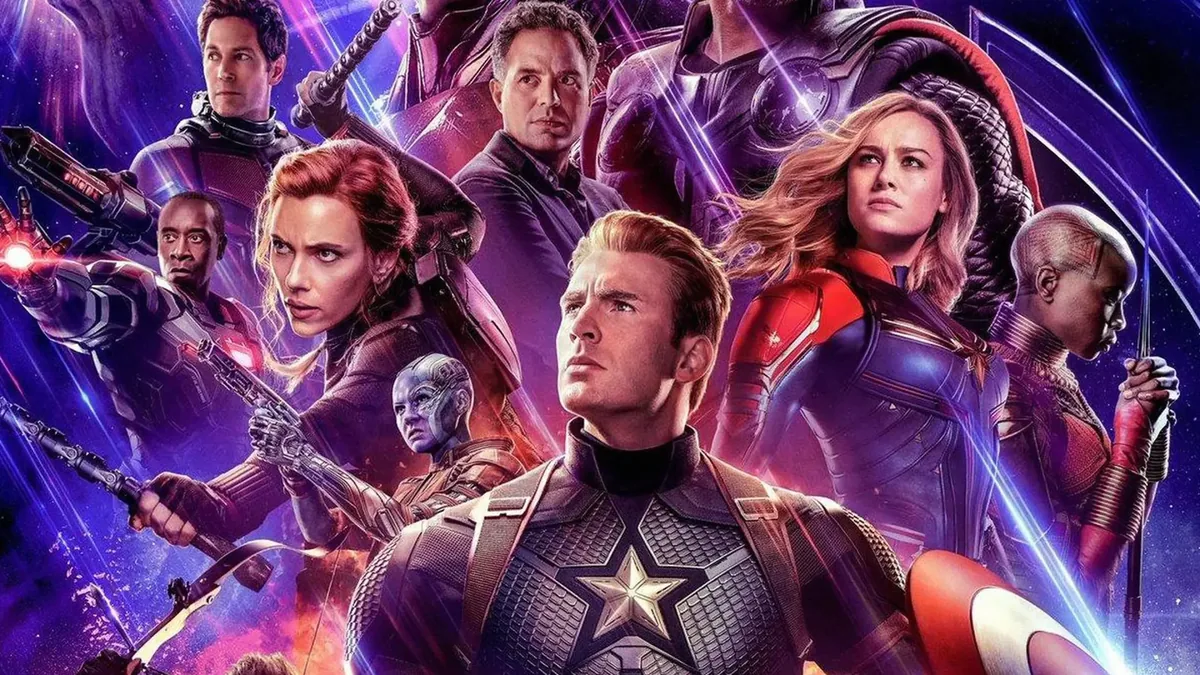
“Avengers: Endgame” no longer ends exactly as we remember. Marvel Studios has reclaimed its 2019 success with “Avengers Endgame: Encore”, an edition that adds four narrative moments, alters the color treatment, and paves the way for “Avengers: Doomsday”.
It’s worth clarifying what “four scenes” means here. We’re not looking at four changes spread throughout the movie: one expands the ending of Steve Rogers and Peggy Carter, and the other three occur around the credits. The addition adds roughly four minutes compared to the original release and functions more as a prologue to the next film than as a revision of the final battle against Thanos.
Warning: from this point there are spoilers for the added scenes in Endgame: Encore and for some recent events in the Marvel Cinematic Universe.
The four new scenes of Endgame: Encore, explained
1. Steve and Peggy’s dance is no longer a closed-off farewell. In the 2019 version, Steve Rogers ends up staying in the past to live with Peggy Carter. Now, a visitor interrupts that intimacy: Loki appears at the door of the house. He doesn’t immediately explain what he seeks, but his arrival turns the apparent ending of Captain America into a story still connected to the time-bending events.
The appearance has a reading special for those who have followed Loki on Disney+. The character went from causing problems in the timeline to becoming a fundamental figure for the balance of the multiverse. His appearance before Steve and Peggy raises an important question: what consequences has Steve’s decision to stay in another era actually had? The scene raises the question, but does not by itself prove that he caused the incursions.
2. Doctor Doom goes to seek Bruce Banner. After the events of Spider-Man: Brand New Day, Banner is confined and trying to control his transformation. Doom’s arrival interrupts his efforts. We hear the Hulk, and the sequence ends without conclusively showing where the character ends up.
The encounter does not confirm that Hulk will work for the villain nor that Doom has stolen his powers. Those are possible interpretations, not facts established by the images. What it does introduce is a direct link between the antagonist of Doomsday and one of the original Avengers.
3. The Time Variance Authority contemplates a crisis of universes. Mobius, Ouroboros and their colleagues follow a chain of incursions that threaten to spread across thousands of realities. Among the affected is Earth-10005, associated with the X‑Men from the Fox films. The scene links what happened in Loki with the continuity clashes Marvel is preparing and broadens the role of the Time Variance Authority in the face of the multiversal collapse.
The presence of that Earth is more significant than any cameo speculation: it allows recognizing that the problem no longer affects only the main MCU continuity. The X‑Men, the Fantastic Four, and the Avengers do not necessarily originate from the same story, and that separation stops being a technical matter and becomes a dramatic conflict.
4. Doom’s mask alludes to the birth of Iron Man. The final addition shows the forging of a mask and deliberately recalls Tony Stark building his first armor. The parallel matters because Robert Downey Jr. now plays Doctor Doom, but it does not confirm that the villain is a variant of Tony Stark or that both characters share identity in fiction.
Beyond its exact order within the montage, each scene serves a distinct function: to reintroduce Steve, to bring Hulk into the conflict, to make the multiversal danger visible, and to place Doom’s face before the memory of Iron Man.
What changes and what Marvel still hasn’t clarified
Tony Stark’s sacrifice, Thanos’ defeat, and the recovery of those who disappeared have not been altered. ‘Endgame’ preserves its main ending, but the new minutes turn several farewells into starting points. The montage is not a secret sequel, though it invites revisiting the meaning of certain events from 2019.
We must also separate clues from certainties: Loki appears before Steve and Peggy, but we do not know the full conversation; Doom approaches Banner, though we don’t know the outcome of that encounter; the multiversal crisis intensifies, without the scene explaining its outcome; and the mask creates a visual association with Tony, not a revelation of identity.
The usefulness of ‘Encore’ is there. Instead of forcing the viewer to remember every series and movie released since 2019, Marvel has placed four connections at the end of a story that millions of people know. That does not substitute for the rest of the Multiverse Saga, but helps explain why “Doomsday” will arrive in Spain’s cinemas on December 17, 2026 with a problem affecting several realities at once.