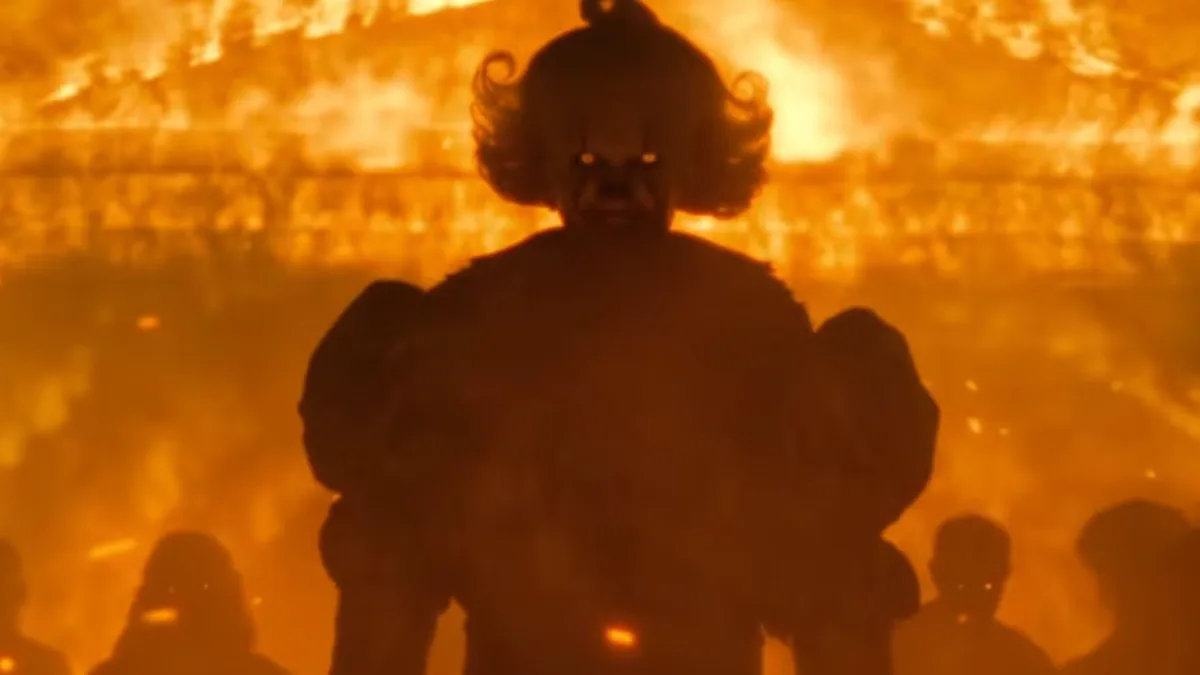
“It: A History of Derry” is not a making-of episode nor a compilation of interviews. It is a 27-minute narrative piece released as a surprise for Halloween, set centuries before the events of It: Welcome to Derry and centered on the Shokopiwath tribe and an ancestral spirit known as Galloo.
The story departs from the protagonists of the first season to look toward a distant past of Derry. Its appeal for Stephen King fans lies precisely at that boundary: the special uses rules, images, and concepts recognizable from It, but also incorporates elements that do not appear under those names in the novel or in Andy Muschietti’s two films.
What Comes From Stephen King’s Universe
The most evident foundation is the very nature of It. In King’s novel, Pennywise is not merely a killer clown, but a manifestation of a cosmic entity whose true form is nearly incomprehensible to human beings. The clown is one of the appearances it uses to lure and terrify its victims.
Also part of the canon is the idea that the creature has been tied to Derry long before the protagonists arrived. The book presents the town’s history as a succession of tragedies, disappearances, and violent episodes in which the presence of It is perceived directly or indirectly.
Another recognizable element is the relationship between the monster and a perception of time that does not function like human time. The storytelling of the first season has teased this possibility by showing that Pennywise seems to know events situated at different points in Derry’s chronology. Yet, the series is developing that idea with greater liberty than the novel.
The Series Is Building On Its Own
The Shokopiwath tribe, the Galloo spirit, and the tale of the youths who venture into the Western Woods do not form part of King’s central mythos in the book. They also do not occupy a place in the 2017 and 2019 films, which simplified much of the novel’s cosmic dimension to focus on the battle between Pennywise and the Losers’ Club.
That does not mean these elements are disconnected from the original material. The series may be taking the idea of an ancient presence tied to Derry and turning it into a concrete legend, with its own names, symbols, and characters. The important difference is that we are not looking at a literal adaptation of a lost chapter of the novel, but at an expansion of the television world.
The special seems to sit in that middle ground: it preserves the sense of ancestral menace intrinsic to It, but expresses it through a story and a mythology that television is crafting for this version. For the viewer, the question is not so much whether Galloo exactly equals It, but what relationship the series will establish between the two figures.
Galloo and Pennywise: Two Names for the Same Monster
With the information available, it would be unwise to assume that Galloo is simply another name for Pennywise. The teaser shows characters tied to the Shokopiwath tribe and a supernatural presence in the forest, but that does not confirm that the clown appears or that the spirit is a direct transformation of the creature.
The distinction may be relevant. In King’s universe, It takes on different forms according to its victims’ fears and uses the image that best allows it to manipulate them. The series, by contrast, could present Galloo as a separate entity, as a local interpretation of the threat, or as a piece of the story that will eventually connect with Pennywise.
The episode does not allow resolving that question without venturing into speculation. Its runtime, moreover, requires telling a very focused story, more interested in fixing an atmosphere and a legend than in developing at length the tribe’s culture or the nature of the spirit.
What Changes Compared to the It Movies
Muschietti’s films kept some essential concepts from the book, but relegated several aspects of its cosmology to the background. The turtle Maturin, the Macroverse, and the Deadlights’ dimension hardly carry the same weight on screen as in the novel, while the cinematic version presents Pennywise in a more direct and physical form.
It: Welcome to Derry has more time to recover part of that mythological breadth. That does not imply it will translate King’s full canon, but it can explore areas the cinema had to summarize: the town’s past, the persistence of violence, and how different generations interpret a threat that returns again and again.
In that sense, the special functions as a demonstration of the series’ possibilities. It does not rely on the Losers or on the most well-known version of the clown, but tests whether the universe can sustain horror tales set in other eras and starring characters outside the main story.
Availability and Place Within the Series
The surprise premiere was announced for HBO Max in several territories, including the United States, the United Kingdom, Ireland, and Latin America. The available information initially did not confirm a simultaneous arrival on HBO Max in Spain, so it is wise to check the app and the local listing before assuming that the episode is included in the Spanish catalog.
The piece runs much shorter than the main episodes of the first season. Therefore it is more appropriate to understand it as a supplementary tale rather than a conventional episode: it provides an additional perspective on the mythology, but it does not replace watching the season nor does it solve all questions about Pennywise on its own.
The series has already established a temporal structure that moves back to other chapters of Derry’s history. The second season is linked to an earlier period, and the creative plans discussed for the production point to continuing to explore different stages of the town’s past. The special fits into that expansion, although it has not been confirmed as a prerequisite for understanding the upcoming season.
The Boundary Between Adaptation and New Mythology
The most interesting decision of the episode is not how much it explains about Pennywise’s origin, but how much space it gives to its own mythology. King’s novel provides the framework: an ancient entity, a town scarred by violence, and a history that repeats. The series adds the local detail, the names, and the narratives that turn that framework into an independent television narrative.
There lies the key to interpreting It: A History of Derry. Its references to Stephen King serve as a starting point, but Galloo and the Shokopiwath tribe belong to the specific language of this adaptation. If the series keeps that separation clear, it will be able to expand Derry without presenting every invention as if it were part of the original canon.