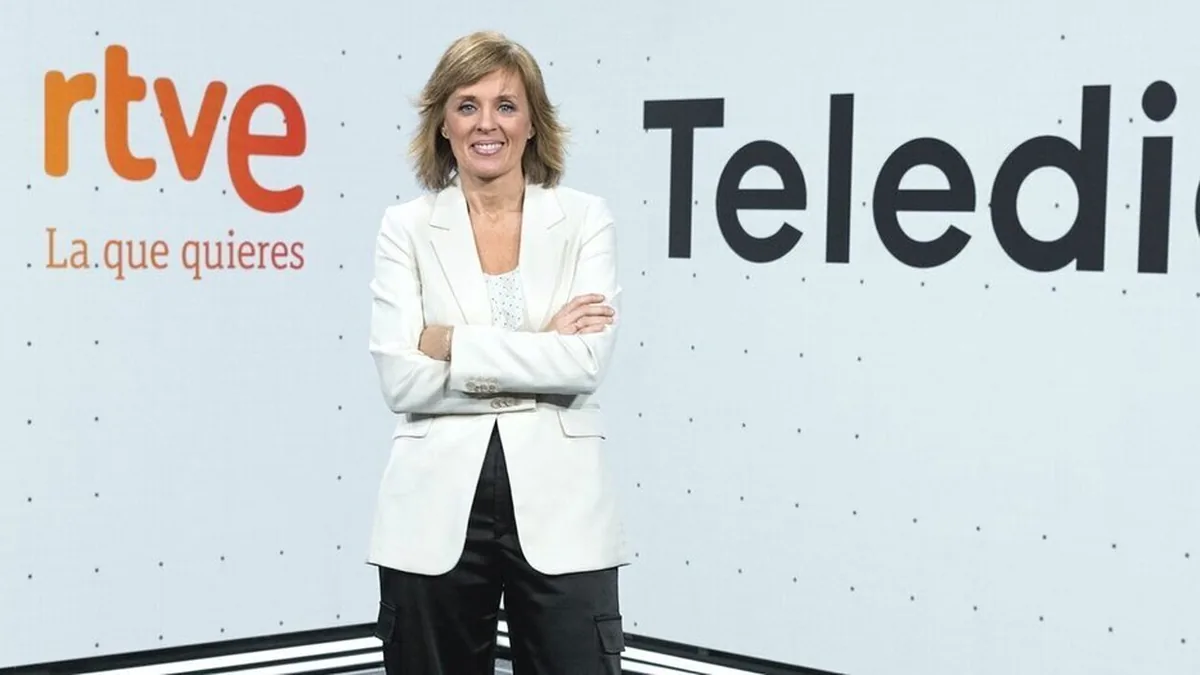
The Telediario 2 on La 1 brought together several generations of faces linked to television news on Monday, October 19, to celebrate the 70th anniversary of TVE. Pepa Bueno hosted a special edition in which professionals such as Ana Blanco, Iñaki Gabilondo, Matías Prats, Pedro Piqueras, Carlos Franganillo, Olga Viza, and Lorenzo Milá appeared together.
The broadcast did not limit itself to reviving familiar names. Its real journey tracked a television that has shifted from using iconic anchors as a near-exclusive reference to a much more collaborative model, supported by correspondents, specialists, new technologies, and technical teams that rarely appear on screen.
A newscast that became collective memory
The program started from the evolution of the Telediario itself. Rather than merely following the day’s current events, the edition reviewed episodes that have marked Spanish public life and the way television brought them into homes.
The choice of guests allowed a look at a turnover that usually remains hidden behind the headlines. Ana Blanco shared the table again with Pepa Bueno, while Carlos Franganillo returned to the studio he had occupied during his tenure leading the night-time news. Their presence helped visualize the continuity between generations, but also the different ways of practicing the craft.
In that progression, one can accommodate everything from Iñaki Gabilondo’s solemn recollection of the coverage of the 23-F to Pedro Piqueras’s experience confronting war conflicts. Also the perspective of reporters such as Almudena Ariza and Anna Bosch, who represent a more field-based international coverage and the explanation of complex contexts.
From the omnipresent anchor to the connected newsroom
For much of television history, the anchor’s face served as a synonym for the news program. The special made clear that this model still holds sway, but it is no longer enough to explain how a story is built on today’s television.
The coverage of the pandemic, the expansion of artificial intelligence, and the transformation of weather reporting all demonstrate a shift in language. The viewer no longer receives just a succession of headlines: they expect data, images, analysis, and tools that allow them to understand increasingly technical phenomena.
That shift is also evident when comparing the television of major events with contemporary coverage. The images of the Moon landing, recalled through Jesús Hermida, belong to an era of broadcasts shared by mass audiences. Today, a health crisis, a war, or a DANA is followed live from multiple screens with constant updates.
The special connected these two moments without presenting technology as an automatic substitute for journalism. Artificial intelligence appeared linked to scientific advances and to new reporting challenges, not as a magical solution for the work of a newsroom.
The reunions that explain the passage of time
Some encounters worked as small capsules of television history. Olga Viza and Matías Prats came together again three decades after the Barcelona 92 Olympic Games, an image associated with a period when major sporting events occupied a central place in the programming.
Together with Jesús Álvarez and María Escario, the sports block allowed recalling the evolution of information about the Spanish national team and the growth of women’s sports presence. It wasn’t just about revisiting successes, but about showing how what television considers relevant and worthy of broad coverage has changed.
Something similar happened with meteorology. The meeting between Mónica López and Paco Montesdeoca served to juxtapose the old television maps with the current explanation of phenomena such as climate change and the DANA. The more accessible language of that block summed up a transformation affecting precision, prevention, and the responsibility of the message.
A story that also belongs to those who do not appear on screen
One of the most meaningful moments came through Rosa María Calaf, who spoke via a pre-recorded message to advocate for the work of technicians, directors, camera operators, and producers. Her presence shifted the focus from the presenters to the structure that makes a newscast possible.
This recognition is especially significant in an anniversary of this kind. Public television is often remembered through its most famous faces, but daily broadcasting relies on a much broader professional network: newsrooms, mobile units, editing, documentation, sound, lighting, and live coordination.
The very idea of gathering former presenters on the set only works because there is a team memory behind each stage. The special turned that professional memory into part of the narrative, while not abandoning the televisual and emotional tone inherent in a celebration.
The closing moment balancing solemnity and humor
The broadcast reserved its final wink for Beatriz Pérez-Aranda and her well-known phrase “as cool as a cucumber.” The closer injected humor into a night marked by memories and prevented the anniversary from being reduced to a sequence of solemn tributes.
The result was a look at seven decades of news programs through their faces, but also through changes in pacing, language, and technology. The journey through the Telediario’s historic faces helps explain that the continuity of the format does not depend on always keeping the same faces.
The celebration left a more interesting idea than mere nostalgia: Telediario remains recognizable because it changes with the society it informs. In that succession of pioneers, veterans, and current professionals lies the program’s true story, a story that does not end with its most remembered presenters.