
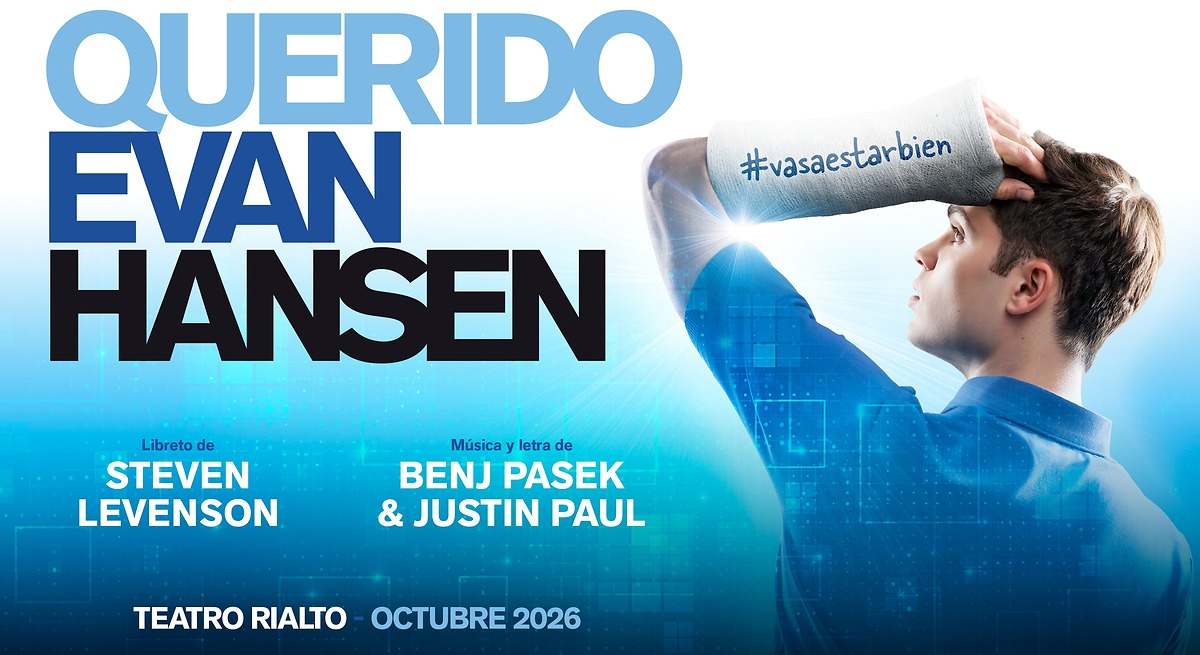
The musical doesn’t always need grand choreographies, monumental sets, or large-scale numbers to move the audience. Sometimes all it takes is a teenager who barely knows how to relate to others, a family trying to understand one another, and songs capable of expressing what the characters cannot say out loud. That is the proposal of “Dear Evan Hansen,” one of the great successes of contemporary musical theatre, arriving at the Teatro Rialto in Madrid on October 23, 2026.
Winner of six Tony Awards, including Best Musical, and of three Olivier Awards in London, the show has built its prestige on an unusual blend: an intimate story, emotionally complex characters, and a score that has managed to transcend the stage. Its main appeal lies not only in teenage conflicts, but in something much more universal: the need to feel loved, heard, and part of other people’s lives.
The Spanish production, directed by David Serrano and starring Guillermo Martín, arrives on a Gran Vía where major international franchises and shows with spectacular visual scale coexist. Dear Evan Hansen offers a different path. Its strength lies in performance, in the relationships between the characters, and in songs that turn vulnerability into theatrical material.
What Dear Evan Hansen is about: a story about feeling invisible
Evan Hansen is 17 years old, suffers from social anxiety, and experiences enormous difficulties in relating to those around him. His therapist has recommended that he write letters to himself in which he tries to imagine that each day might become a good day. It seems like a simple exercise, but for someone who lives wrapped in how others see him, finding reasons to trust himself proves challenging.
Everything changes when one of those letters ends up connected to Connor Murphy, a high school classmate whose death shakes his family and the school community. A misunderstanding triggers a chain of events that places Evan at the center of attention he had never received before.
The plot involves a lie and its consequences, but reducing the musical to that conflict would leave out much of its richness. Steven Levenson’s book explores identity, isolation, grief, family relationships, friendship, and the social pressure that accompanies the desire to fit in.
Evan wants to stop being invisible, even though he doesn’t always know how to achieve it. Other characters need to understand a loss, rebuild bonds, or find a way to express feelings they have kept hidden for far too long. Each one faces a different kind of loneliness.
That is one of the show’s most interesting features: it doesn’t talk only about a teenager struggling to relate, but about people living together without fully understanding what’s happening to those closest to them.
The story tackles delicate issues, including suicide, without turning the show into a somber piece. There are moments of humor, affectionate bonds, bright songs, and scenes that allow some distance from the pain. This alternation is essential for the narrative to work as theatre and not as a sequence of personal problems.
A soundtrack that explains why the musical has moved so many audiencesMusic is one of the main reasons Dear Evan Hansen has developed its own identity within contemporary musical theatre.
The songs are written by Benj Pasek and Justin Paul, composers also known for their work on La La Land and The Greatest Showman. Their score moves between pop, ballads, and the language of musical theatre, with accessible melodies that conceal an emotionally demanding writing for the performers.
But the merit isn’t just in having composed memorable songs. Each of the major musical numbers provides access to a different dimension of the characters.
In Waving Through a Window, Evan expresses his sense of observing the lives of others from the outside, as if there were a barrier preventing him from taking part fully. The song turns a difficult-to-articulate experience into something immediate for the audience.
For Forever develops the longing to experience a deep friendship and to hold onto a meaningful memory, while Requiem introduces a particularly complex dimension of grief: members of the same family do not have to remember a deceased person in the same way.
There is also room for a different sensitivity in So Big/So Small, one of the numbers linked to the Evan-and-mother relationship. The song belongs to that category of theatrical moments whose strength lies in recognizable family experiences, without needing grand explanations or stage effects.
And then there is “You Will Be Found,” the Spanish adaptation of You Will Be Found, which has become the show’s great anthem. Its message of support and hope has decisively contributed to the show’s international popularity.
The song sums up one of the aspirations that run through the entire story: that no one should have to assume they are completely alone. Within the musical it also gains narrative complexity that prevents it from being read as merely an optimistic statement.
The Spanish production has already offered a preview of You Will Be Found performed by the cast, a first glimpse of how one of the show’s best‑known songs sounds in Spanish.
A musical about teenagers that also speaks about parents, mothers, and families
One of the reasons Dear Evan Hansen can connect with viewers across generations is that its story does not limit itself to the teenage perspective.
Family relationships are as crucial as teenage conflicts.
Heidi Hansen, Evan’s mother, tries to balance her duties and her efforts to support her son with the difficulty of understanding what he is experiencing. She is a pivotal character because she introduces a reality that many coming-of-age tales barely explore: the distance that may exist between wanting to help someone and knowing how to do it.
The Murphy family represents another dimension of the story. Cynthia, Larry, and Zoe face a loss from distinct emotional standpoints, and their reactions show how grief can transform relationships among people sharing the same home.
The work does not present friendship, love, or the need for acceptance as quick fixes to complex problems. Its characters make mistakes, contradict themselves, keep silences, and seek affection without always having the tools to relate in a healthy way.
That weave is what makes a story set in a US high school feel recognizable to an adult spectator in Madrid.
The fear of disappointing others, the difficulty of talking to parents, or the desire to feel important to someone do not vanish after adolescence ends. They change their circumstances, but they remain part of human relationships.
And that explains the emotional intensity of the show: it doesn’t rely on the audience having lived the same situations as Evan, but on recognizing feelings present in their own experience.
From Broadway to Madrid: six Tony Awards and an international phenomenon
Dear Evan Hansen began its journey in 2015 at the Arena Stage in Washington. It later moved through the New York circuit and reached Broadway in December 2016, where it cemented its success.
The show won six Tony Awards in 2017, including Best Musical, Best Book for Steven Levenson, and Best Original Score for Pasek and Paul. Ben Platt was also recognized for his lead performance, Rachel Bay Jones as featured actress, and Alex Lacamoire for the orchestrations.
The work later added the Grammy for Best Musical Theater Album, and in its London production, three Olivier Awards, including Best New Musical.
The recognition is meaningful because the show did not conform to the most common blockbuster musical model. It wasn’t built around a successful movie, a known franchise, or a catalog of previously popular songs.
Its main draw was the story itself.
Moreover, its development coincided with a shift in cultural conversations about mental health, the exposure of private life, and the impact of social networks. The musical made these issues central to its dramaturgy without abandoning a structure of recognizable characters, relationships, and songs for the general public.
Digital exposure is part of the show, but its relevance does not depend on a specific platform. The problem runs deeper: a permanently connected society does not guarantee that people feel accompanied.
That contradiction remains one of the elements best explaining the show’s cultural interest a decade after its original premiere.
Guillermo Martín and David Serrano lead the Spanish adaptation
The arrival of Dear Evan Hansen to Madrid also presents an artistic challenge for a production that must translate a work heavily dependent on the relationship between text, music, and performance into Spanish.
Guillermo Martín plays Evan Hansen, a character who must convey insecurity and vulnerability without letting those traits become a caricature. It is not only about tackling some of the repertoire’s most demanding vocal numbers, but about making a protagonist whose evolution relies as much on the big musical moments as on the pauses and silences believable.
He is accompanied by Iván Clemente as Connor Murphy, Elvira Santa María as Zoe, Verónica Ronda as Heidi Hansen, Lorena Calero as Cynthia Murphy, Armando Pita as Larry Murphy, Arnau Camps as Jared Kleinman and Jessica Garcés as Alana Beck.
Direction and staging are by David Serrano, who also co-authors the adaptation with Alejandro Serrano. Joan Miquel Pérez takes on the musical direction, while David Pizarro handles set design, Carlos Torrijos the lighting, and Iker Carrera the movement direction.
The production is managed by ATG Entertainment España.
The staging blends the performers’ work with audiovisual elements that reflect the presence of social networks in the characters’ lives. The dramatic aim isn’t to showcase technology for its own sake, but to integrate that digital universe into a story where privacy and public exposure are constantly intertwined.
Why Dear Evan Hansen is a different musical on Madrid’s bill
The premiere takes place during a season particularly crowded for Madrid’s musical theatre, with titles such as The Lion King, Wicked, Les Misérables, or We Will Rock You sharing the spotlight with the show.
Not all productions compete with the same tools.
While some productions stand out for visual spectacle, character recognition, or the strength of familiar songs, Dear Evan Hansen places the protagonists’ intimacy at the forefront.
Its core is eight characters, and the musical structure gives extraordinary weight to personal conflicts. That choice alters the audience’s relationship: the emotion depends mainly on what the characters tell, hide, and uncover during the performance.
In a city used to measuring a musical’s growth by the scale of its productions and the popularity of its brands, the arrival of a title of this kind broadens the range of experiences available.
It also reminds us that musical theatre can address difficult topics without giving up entertainment. The presence of memorable songs, humor, and hopeful moments does not erase the argument’s complexity. It is precisely this blend of registers that has allowed the show to reach different audiences.
The musical does not offer universal answers about loneliness, family relationships, or mental health issues. Its field is fiction, not clinical guidance. But it can spark conversations that feel meaningful after the performance.
And that capacity to turn hard-to-express feelings into shared experiences is one of the reasons musical theatre continues to have its own language.
When Dear Evan Hansen debuts in Madrid, how long it runs and where to buy tickets
The Spanish production of Dear Evan Hansen is scheduled for its official premiere on Friday, October 23, 2026 at the Teatro Rialto, located at 54 Gran Vía in Madrid.
Madrid’s official Tourism schedule and the theatre’s program advertise performances through December 20, 2026, though one of ATG’s sales pages still lists November 29 as the final date. It is advisable to consult the updated calendar when choosing a performance.
| Information | Detail |
|---|---|
| Musical | Dear Evan Hansen |
| Official premiere | October 23, 2026 |
| Theatre | Rialto, 54 Gran Vía, Madrid |
| Season announced | Through December 20, 2026 |
| Tickets | From 25 euros on the official channel |
| Duration | 2 hours 15 minutes, plus 20-minute intermission |
| Recommended age | From 13 years |
| Direction | David Serrano |
| Protagonist | Guillermo Martín |
| Production | ATG Entertainment España |
Shows run from Tuesday to Sunday, with times varying by day and possible changes on holidays. Prices depend on the date, seating location, and available promotions.
Tickets can be consulted on ATG Tickets’ official website.
A musical that reminds us of the importance of feeling accompanied
There is something especially valuable about a production of this scale using the tools of musical theatre to speak about people who struggle to find their place.
Dear Evan Hansen does not need to present exemplary characters or resolve all their conflicts in a reassuring way. Its interest lies in showing how hard it can be to relate, to express what one feels, or to understand someone you care about.
The songs provide a channel of expression that everyday conversation does not always offer. Music allows thoughts, desires, and fears to be voiced that would remain hidden in a conventional dialogue.
That is why, beyond its awards and the international popularity of its soundtrack, the arrival of Dear Evan Hansen in Madrid has its own cultural significance. It adds a major musical to the lineup that places vulnerability, family, and human bonds at the center of the theatrical experience.
Its central theme is not only loneliness. It is the need to find someone capable of recognizing it.
And few ideas are as fitting for theatre as this one, a place where strangers sit together for two hours and may discover that they share emotions they believed were exclusively theirs.
The keys
- The premiere: Dear Evan Hansen, winner of six Tony Awards, arrives at Madrid’s Teatro Rialto on October 23, 2026.
- Its depth: the musical addresses social anxiety, loneliness, grief, family relationships, and the need to belong from multiple perspectives.
- The music: Benj Pasek and Justin Paul deliver a score that blends big, emotional songs with intimate moments that help audiences understand the characters better.
- The Spanish version: Guillermo Martín stars in the production directed by David Serrano, with performances announced through December 20.