
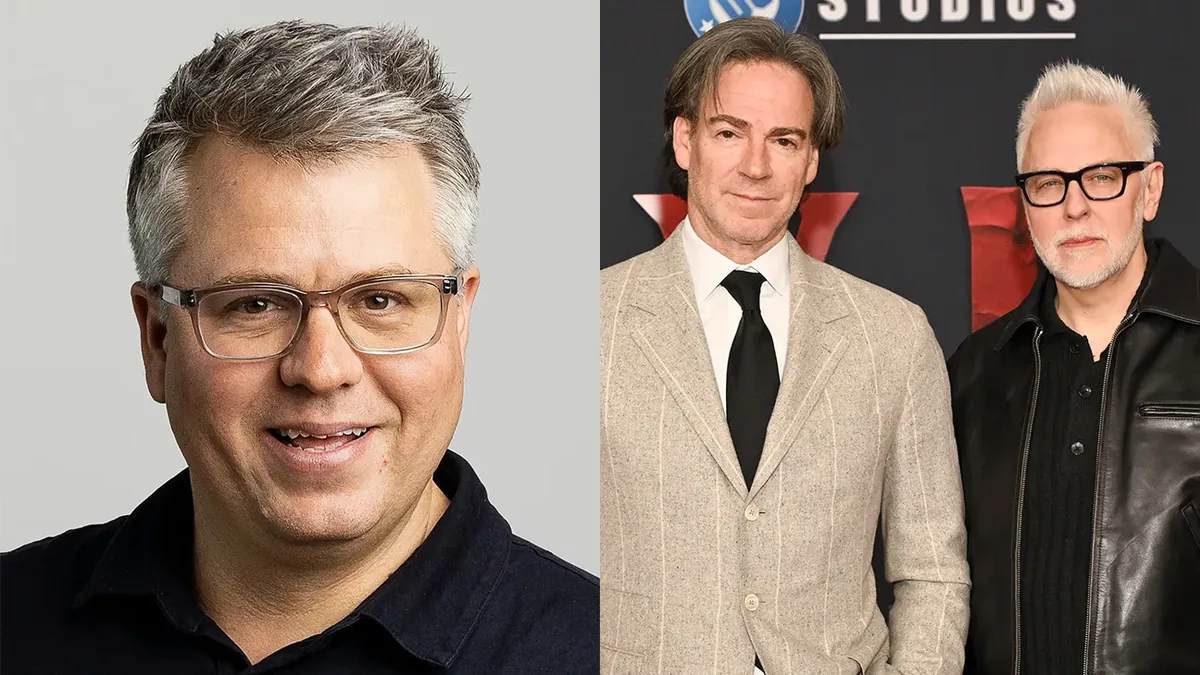
James Gunn and Peter Safran will leave their posts at the helm of DC Studios after four years at the helm of the division. Their successor will be Jeremy Latcham, a producer with a long track record at Marvel Studios and credits on films such as Iron Man, The Avengers and Guardians of the Galaxy.
The change affects the person overseeing DC’s global strategy, not merely a single film. Latcham will assume coordination of films, TV series, and animation projects, while Gunn and Safran will remain tied to creative tasks and will collaborate during the transition, according to the information released about the reorganization.
A Changeover Amid DC’s Rebuilding
The departure comes as DC is still trying to consolidate the reboot of its audiovisual universe. Gunn and Safran arrived at the helm with the aim of bringing order to a franchise that had accumulated shifting plans, disconnected projects, and uneven box-office results.
Their proposal was to build a shared continuity from a new base, with Superman as theStarting point. The film would have reached $618 million worldwide at the box office, a figure that allowed presenting the project as a relaunch capable of rekindling audience and critical interest.
However, a cinematic universe is not sustained solely by the performance of its first major release. The real challenge lies in maintaining a recognizable direction as productions with markedly different tones, characters, and objectives arrive. That will be Latcham’s first test.
Who is Jeremy Latcham, the new head of DC
Jeremy Latcham joined Marvel in 2004 and contributed to the development of several of the films that helped define the Marvel Cinematic Universe. Among his credits are Iron Man, The Avengers, Guardians of the Galaxy, Avengers: Age of Ultron and Spider-Man: Homecoming.
His profile differs from Gunn’s. The former DC creative head arrived with a clearly marked authorial identity and direct experience as a screenwriter and director. Latcham, by contrast, represents a production figure used to working within franchise structures and coordinating large teams around a shared roadmap.
That contrast could be significant for DC’s future. The studio does not merely need new stories for Batman, Superman, or Supergirl; it must decide how its films and series fit together, which projects belong to the same continuity, and which operate on the margins of it.
What remains after the Gunn and Safran era
The two executives’ tenure broadened DC’s television reach with titles like Peacemaker and Lanterns. The former proved that a supporting character could sustain a series with its own personality, while the latter faced the challenge of translating the Green Lantern universe into a series format with a thriller-like tone.
The continuity of those projects and their placement within DC’s overall plan will be among the questions the new leadership must clarify. It remains to be seen whether the leadership change will affect already announced films or if the priority will be to complete the planned slate before making changes.
Among the titles still on the horizon are Batman 2, as well as Superman: Man of Tomorrow. The handover does not in itself imply that these productions will be canceled or restarted: any modification would require official confirmation.
The problem isn’t only the box office
Recent commercial results explain part of the pressure surrounding the studio. Supergirl would have grossed $126 million worldwide against a production budget of $170 million and an estimated advertising investment of $120 million, according to the data released with the news.
Beyond the final figure, the case illustrates a common difficulty in superhero franchises: a well-known brand does not guarantee that every character will automatically find their audience. DC’s strategy will need to combine popular recognition, budget control, and a sufficiently differentiated proposition to prevent each release from seeming like an isolated gamble.
Therefore, the appointment of Latcham can be interpreted as an attempt to strengthen the studio’s industrial management. His Marvel experience does not guarantee he can replicate that model at DC, but it does bring knowledge about coordinating a long-running franchise without losing sight of each film’s identity.
The transition will be as important as the appointment
Gunn and Safran will not disappear from DC’s ecosystem immediately. Their collaboration during the handover aims to preserve the continuity of ongoing projects and prevent the leadership change from becoming another abrupt rupture for the studio.
The key will be to know what leeway they will retain in creative development and which decisions will be passed directly to Latcham. It will also be crucial to determine whether the new head maintains the idea of a connected universe or if he leans toward a more flexible structure, with films linked to one another and others entirely independent.
For Spanish audiences, the most visible effect may not be immediate: upcoming releases and series could keep their plans while the leadership is reorganized. The change will manifest more in the medium term, when DC must present new projects and demonstrate that there is a coherent through-line behind them.
Gunn and Safran’s departure closes a brief yet decisive era. Their greatest legacy will be having attempted to transform DC Studios into a creative unit with a common strategy; Jeremy Latcham’s challenge now will be to prove that this structure can endure the turnover of its initial architects.