
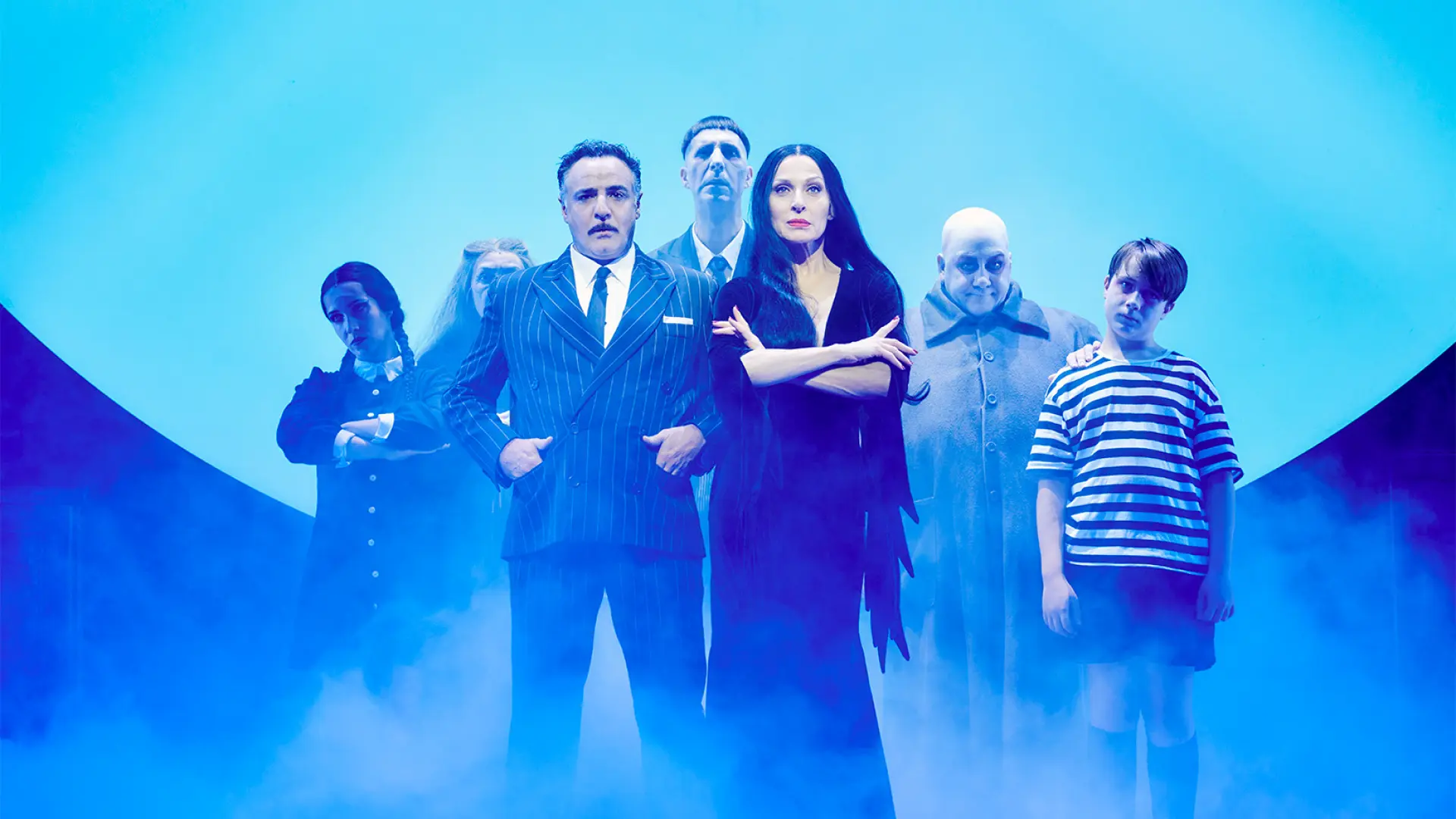
The mansion spins on itself, six curtains cascade open, and the special effects cascade across the Calderón Theatre stage. The new production of The Addams Family, driven by Beon Entertainment and LETSGO, has turned its scenic deployment into one of the main arguments to win over Madrid audiences. But behind so much theatre machinery lies a far less spectacular question: what happens to the music, the direction, and the artistic balance when a large part of a blockbuster’s ambition seems focused on what the audience can photograph.
The version premiered in September 2026, directed by Federico Bellone, does not start from scratch. It revives a musical by Andrew Lippa that has been staged in numerous countries and that already visited Madrid in 2017. Therefore, the debate should not center on the virtues or flaws of the international librettos, but on the decisions made for this new staging. There is where the producers’ responsibility begins.
And there are reasons to question those priorities. While the promotional campaign meticulously describes visual effects, the moving architecture, and stage illusions, the instrumentation chosen for the production has drawn objections for its reduction relative to the twelve-musician score. The new Spanish adaptation also incorporates contemporary references whose integration into the Addams universe deserves critical appraisal.
The problem, ultimately, is not that Beon Entertainment wanted to make a big show. It is whether they have been ambitious enough with all the elements that turn a show into a good musical.
Beon Entertainment has built an extraordinary mansion. And everything else?
The promotional presentation of this version is especially revealing. The official website describes six backdrops opening in sequence, a life-sized house that moves forward and turns, special effects, illusions, and stage transformations designed to surprise.
The mansion designed by Federico Bellone is probably the element that best encapsulates the producers’ proposal. It does not merely set the scenes; it aims to become an additional character.
There is an indisputable technical ambition in that approach. The problem begins when the building risks taking on more prominence than the musical and dramatic decisions that should give meaning to the whole.
Spectacle is not automatically a virtue. A rotating platform can offer excellent imagery and, at the same time, contribute little to the evolution of a scene. A special effect can surprise without necessarily improving the pace of the show. And complex scenery alone does not make direction theatrically innovative.
Beon seems to have bet on a very specific idea of grandeur: the more the stage transforms, the greater the sense of spectacle must be. But true theatrical sophistication does not depend on the number of moving parts, but on how well they integrate with what happens between the characters.
In fact, Bellone’s direction leans toward a fairly traditional structure in the development of the comedy, despite the modernity of its visual resources. That choice can work as entertainment, but it also invites a discussion about the distance between the promise of an extraordinarily innovative staging and a scenic proposal that uses its biggest surprises in the technical realm.
The house turns. The question is how much the theatrical language around it actually evolves.
The great musical contradiction: a stage design that grows and an orchestra that reduces
If there is one aspect especially delicate for a company that produces musicals, it is the treatment of the music.
The cast sheet for The Addams Family, published by its theatrical rights distributor, Theatrical Rights Worldwide, lists an instrumentation for twelve musicians. It includes two keyboards, woodwinds, brass, strings, bass, guitar, and percussion. It is not a symphonic orchestra, but a lineup designed to offer a considerable variety of timbres and sonic combinations.
In the Madrid production of 2026, under the musical direction of Julio Awad, a substantial reduction of that ensemble has been noted. A professional review of the production published in Teatro Madrid expressly questions the loss of instrumental richness and describes a sound that is more uniform and less nuanced.
The exact number of musicians involved in the Calderón could not be independently verified, and it would not be rigorous to attribute that decision to a savings policy without knowing the producers’ technical and artistic criteria. But the matter deserves an explanation from Beon Entertainment and LETSGO.
Because there is a fundamental difference between making a musical sound loud and making it sound rich.
Amplification, keyboards, and sound-production resources can achieve highly impactful results. They are not inherently artistically inferior by definition. But they do not automatically replace the expressive possibilities of a broader instrumentation.
Timbre contrasts, dynamics, and the small details of orchestration form part of a score’s personality. Their treatment can decisively influence the energy of musical numbers and the relationship between singing and accompaniment.
The contradiction is especially striking because the campaign for The Addams Family itself presents the music as one of its major attractions. It speaks of orchestral references to genre classics and of a proposal that constantly plays with the codes of musical theatre.
Precisely for that reason, it is appropriate to demand clarity about how its interpretation has been conceived.
What criterion justifies giving such prominence to the stage machinery while opting for supposedly more reduced instrumentation? What is gained with that decision and what could be lost in terms of expressivity?
These are very important questions in a production of this character.
A producer who claims to raise the level of Spanish musical theatre should be especially interested in answering them.
An adaptation that seeks immediate laughter at the expense of risking the show’s identity
Another specific decision in this production lies in the Spanish adaptation of the libretto, credited to Romeo Urbano.
Translating a musical comedy requires much more than finding literal equivalents. Wordplay, cultural references, and the construction of jokes must work for an audience that does not necessarily share the codes of the country where the work was written.
Updating certain references can be perfectly reasonable. The problem is turning that update into a recurring mechanism for easy complicity.
The Madrid staging includes nods to contemporary Spain, recognizable allusions to other shows, and moments of direct interaction with the audience.
These are devices that can work in isolation. However, their accumulation poses an evident risk: turning a comedy with a very defined identity into a sequence of occurrences aimed at provoking an immediate response in the house audience.
The Addams Family does not need to resemble a current-events comedy to remain relevant. Its humor has precisely the ability to observe society from a different logic.
When external references take up too much space, the work becomes more dependent on recognizing those nods than on the personality of its protagonists.
The issue is not to reject any updates to the text. It is to require that each intervention has a dramaturgical justification and not simply to facilitate a quick laugh.
This is where the adaptation work of this version deserves particularly demanding scrutiny. Not because the original musical is untouchable, but because a new production should improve the work’s relationship with its audience without diluting what makes it distinctive.
A first-rate cast should not become the solution for everything
One of the strongest arguments in favor of the production is its cast.
Natalia Millán as Morticia, Javier Navares as Gomez, and Cristina Picos as Wednesday lead a company with substantial experience in musical theatre. The show also features performers such as Omar Calicchio, Amparo Saizar, Javier Canales, Pepa Lucas, and Juanan Plazas.
The quality of a company constitutes a major artistic merit, also for those who select it. Beon Entertainment and LETSGO have gathered professionals capable of sustaining a production of this scale.
But the talent of the cast should not serve as a pretext to overlook the direction, adaptation, or musical treatment decisions.
A great performer can elevate a scene, add nuance to a simple situation, and make a musical number especially engaging. What they should not do is systematically compensate for limitations that stem from the general choices of the production.
That distinction matters because the quality of a production cannot be measured solely by the sum of good professionals on its cast list.
It must also assess how their talent is used, how much space is given to performance versus stage machinery, and to what extent the technical resources serve those who work on stage.
Artistic direction consists precisely in organizing those priorities.
The Calderón return that forces us to ask what Beon really contributes
There is another element that distinguishes this staging from any international presentation of The Addams Family: the show had already played the same Madrid theatre nine years earlier.
The 2017 production was driven by LETSGO, with Esteve Ferrer in the stage direction. The 2026 version brings Beon Entertainment on as a co-producer and presents a new rendition under the direction of Federico Bellone, with a different creative team, a different adaptation, and a renewed cast.
In other words, this is not a premiere introducing a previously unknown work to Spain.
It is a new reading of a title that Madrid audiences had already experienced.
That raises the interest of a question that usually goes unnoticed in promotional campaigns: what artistic justification exists for producing the same musical again in the same venue?
The answer cannot be limited to saying that a new mansion has been built or that certain special effects have been incorporated. Those are production differences, but they do not by themselves explain the artistic necessity of a new version.
It would be interesting to know what objectives Beon and LETSGO set for the previous staging. What did they want to improve, which aspects did they decide to preserve, how was the musical treatment chosen, and what specific contribution did they seek with the Spanish adaptation?
Because reviving a known title can make perfect commercial sense. Endowing it with its own artistic purpose requires something more.
A new production should not justify its existence solely by showing that it can build a more striking set.
Beon Entertainment’s The Addams Family: is merely impressing enough?
The new Madrid version has evident attractions. Its cast is one of them. The rotating mansion and the scenic work are others. It is entirely understandable that a show conceived as a grand musical comedy would focus its efforts on entertaining and surprising audiences.
But acknowledging those virtues does not obligate us to accept all of its producers’ decisions uncritically.
Beon Entertainment and LETSGO have chosen to make their scenic investment especially visible. What they owe us is an equally recognizable ambition in the musical direction, the adaptation work, and the integration of all the show’s elements.
That is the real debate posed by this version of The Addams Family. Not whether the original musical is good or bad, nor whether its characters deserve to continue traveling the world. The show has already proven its ability to reach new audiences.
The question is what this Madrid production contributes and whether its leaders have given each artistic discipline the prominence it deserves.
In an industry that competes to offer increasingly elaborate experiences, it would be worrying if the complexity of a scenic design ended up being the main measure of excellence.
Musical theatre is not built solely on what can move on stage. It is also built on sound choices, interpretive decisions, and dramaturgical ones that may not be easy to capture in promotional videos, but that determine the quality of a performance.
The mansion of The Addams Family can spin as many times as its creators want. The truly interesting question would be to determine whether Beon Entertainment has put the same effort into expanding everything that happens inside it.