
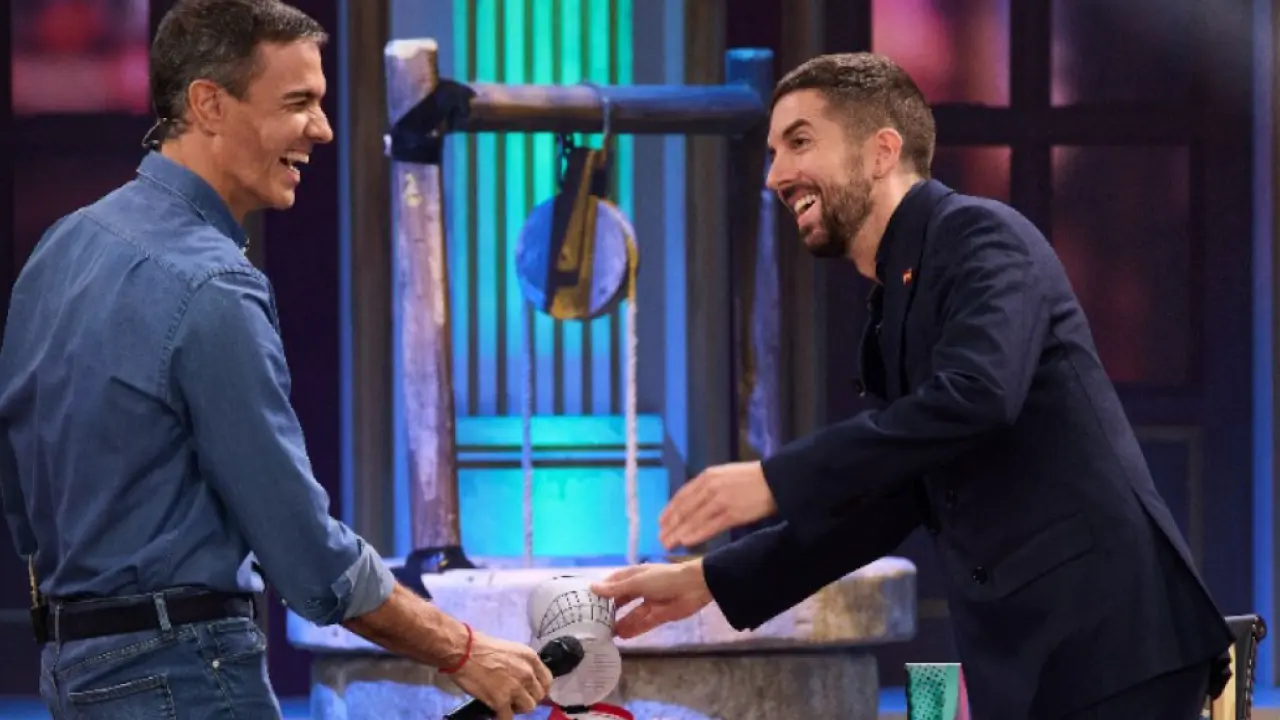
Pedro Sánchez arrived at La Revuelta ready to demonstrate that he can also be a close, spontaneous guy with a sense of humor. He sat on the couch, picked up the plush dog he had beside him, and settled in with that carefully managed naturalness of someone who has spent too many years surrounded by communications advisers. I don’t know if the dog part was rehearsed. Probably yes. Maybe it’s paranoia, but watching the president, one gets the feeling that even his spontaneous gestures have already gone through a strategy meeting.
The interview had all the ingredients to become a pleasant stroll. A president in pre-campaign, an entertainment show his opponents have accused for years of being close to the government, and a host who has never pretended to be a political journalist. On paper, a magnificent opportunity to humanize Sánchez, offer a few smiles, and return to Moncloa with several charming videos for social networks.
On paper.
Because something much more interesting happened. David Broncano gave an interview. And, to the surprise of those who expected a ceremony of television complicity, he did it reasonably well for what we’re used to.
Broncano, more serious than expected
We must give Broncano credit for something that isn’t always granted to those who come from entertainment: he understood the importance of the guest without betraying the show’s nature. He was more serious than usual, listened, asked, and managed to bring in much of the controversies that have accompanied the government over these years. Corruption, Ábalos, housing, Ceuta, tensions with the judiciary, and the president’s political problems had their moment.
It wasn’t an investigative interview. Nor was it meant to be. There were questions that deserved greater depth and answers that would have required a more awkward follow-up. But it would be absurd to expect Broncano to suddenly become a prosecutor at the Supreme Court with a ping-pong table.
What was interesting was precisely the balance. Broncano managed to be incisive without being aggressive. He asked without raising his voice. And, above all, he allowed humor to do part of the work that in other interviews would require direct confrontation.
Because jokes can also be questions. Sometimes, even, questions especially difficult to answer.
We saw it when jokes about Zapatero and gifts appeared, when Tezanos was mentioned, or when Ricardo Castella and Grison used their turns to insert those kinds of comments that are harmless until you remember who is sitting opposite. The audience laughed. Sánchez, far less.
He wasn’t permanently serious, of course. There was complicity, some funny responses and moments when he joined in. But when the humor brushed against the most delicate issues, spontaneity seemed to run out of cover.
Of course, with all the serious scandals this government has faced, the last thing you would expect is the interview to be a stroll. But in this world of politics and media, sometimes so crude, in which we have to live, as long as Broncano was a bit critical, it felt like a top-tier interview (which, of course, it wasn’t).
The problem of not controlling the joke
Sánchez is an extraordinarily trained politician in communication. He has proven it for years, especially in electoral campaigns. He knows how to occupy space, extend an answer, shift the focus, and turn an uncomfortable question into an opportunity to explain his political program.
In La Revuelta he tried again. On several occasions he seemed more interested in developing his talking points than letting the conversation advance. It’s a perfectly recognizable strategy: the more time the interviewee talks, the less time the interviewer has to ask questions.
The problem is that Broncano does not play exactly by the same rules as a political journalist. And much less so Grison or Ricardo Castella.
In a conventional interview, the president can anticipate the awkward issues and prepare his answers. In a comedy show, however, anyone can introduce a seemingly innocent monstrosity that exposes a political contradiction. No need to formulate an accusation. Sometimes a line launched from the side of the stage is enough.
And there Sánchez was less comfortable.
His response to some of those jabs was silence, accompanied by an expression that seemed to drift between institutional courtesy and the desire for someone to change the subject. A reasonable strategy. Arguing with a comedian over a joke is usually a pretty effective way to keep the joke alive for several more days.
There is something especially revealing in watching a politician used to controlling his public appearances face a setting where he cannot fully control the tone. He can direct a press conference, master a debate, or turn an interview into a rally. What he cannot do is decide when the audience should laugh.
And even less what.
🤬 El odio que genera Pedro Sánchez
«Se acuerdan de mi madre, yo también me acuerdo de las suyas…»
#LaRevuelta @sanchezcastejon https://t.co/cTYwdX2xxh
— La Revuelta (@LaRevuelta_TVE) October 22, 2026
Broncano’s discreet victory
I don’t think Sánchez came out too harmed from La Revuelta. That would be an exaggeration. He answered difficult questions, defended his management, and had enough time to convey his electoral messages. But I also don’t think the interview benefited him too much. He didn’t come across as the particularly affable and poised president that might have been beneficial to show.
The one who did come out strengthened was Broncano.
He faced a delicate test. If he treated Sánchez with excessive complacency, he would confirm the prejudices of those who see La Revuelta as a recreational extension of Moncloa. If he adopted artificial aggression to prove independence, he would have betrayed the style that has made his show a success.
He chose a smarter path. He did his show, but understood that that night the guest wasn’t an actor promoting a movie.
And that decision has an interesting consequence for the weeks ahead.
Sánchez confirmed he will also go to El Hormiguero, where he will presumably encounter a more direct, more combative Pablo Motos, and far less willing to let certain issues slip. It will be another kind of interview, with different rules and probably other discomforts.
But Broncano has shown that his sofa can welcome politicians without turning into a propaganda office. That should make it easier for other candidates, including those on the right, to sit there. And it would be healthy if they did. A public television that invites everyone and lets its hosts do their job, without having to hand out certificates of ideological allegiance, provides a far more valuable service than a string of complacent interviews.
In the end, the night left a curious paradox. Sánchez went to show that he could handle himself naturally in comedic territory, but he didn’t succeed. Broncano, who had the obligation to make people laugh, discovered that he could also unsettle without stopping being entertaining.
The president came out slightly worse for wear. The host, far better than many had expected.
And perhaps that is the best news of the interview: that in a country where much political journalism confuses toughness with shouting and independence with carefully choosing who to trouble, a comedian reminded us that you can ask questions politely, make people laugh, and hold power to account without having to wear a judge’s robe.
Sánchez got across his messages. Broncano kept the show.
And the sofa turned out to be far less comfortable than it seemed.