
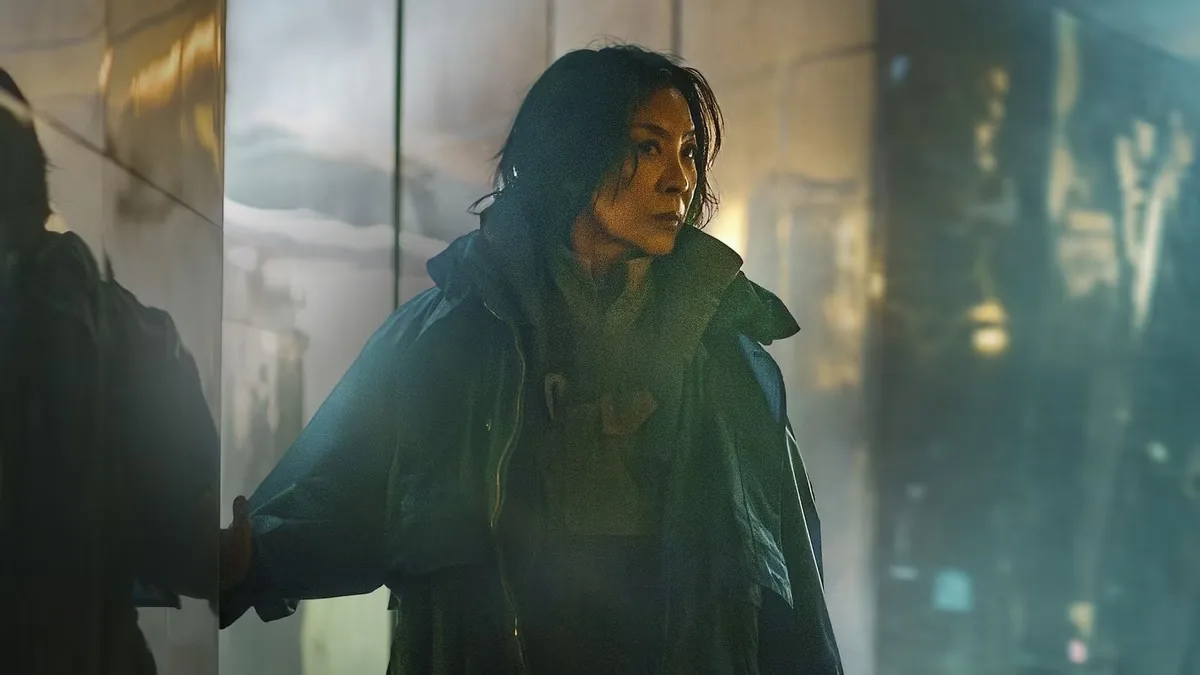
In 2017, before Denis Villeneuve released Blade Runner 2049, three short films explained what had happened in Rick Deckard’s world since Ridley Scott left it. One of them tells of a blackout that jeopardizes the documentary memory of the replicants; another, the return of their manufacture; the third introduces a pivotal character in the film. All three prove useful again now that Prime Video releases Blade Runner 2099 on November 25.
The new miniseries, starring Michelle Yeoh and Hunter Schafer, takes place fifty years after Villeneuve’s film. If we count from Harrison Ford’s first feature, it amounts to eighty years of fiction: from 2019 to 2099. However, not all of those years have been told with the same level of detail.
This guide gathers the seven main audiovisual productions and distinguishes the interstitial stories that explain the evolution of the universe from the questions that remain open before the series premieres. It does not include comics, novels, or video games.
The Chronological Viewing Order for Blade Runner
| In-Universe Year | Production | Release |
|---|---|---|
| 2019 | Blade Runner | 1982 |
| 2022 | Blade Runner Black Out 2022 | 2017 |
| 2032 | Blade Runner: Black Lotus | 2021 |
| 2036 | 2036: Nexus Dawn | 2017 |
| 2048 | 2048: Nowhere to Run | 2017 |
| 2049 | Blade Runner 2049 | 2017 |
| 2099 | Blade Runner 2099 | 2026 |
2019: the origin of the conflict. In Scott’s film, Deckard pursues the replicants, artificial beings created by the Tyrell Corporation to perform jobs such as space colonization. They are capable of experiencing emotions and fighting for their survival. The gap between the purpose for which they were manufactured and their individual aspirations fuels the film’s dilemma, including the ambiguity about Deckard’s own nature.
The Short Films Explaining the World of 2049
2022: a blackout that alters collective memory. Shinichirō Watanabe, director of Cowboy Bebop, created Black Out 2022, an animated prologue in which a far-reaching technological disruption destroys records and upends the established order. Its relevance to the sequel is concrete: it helps explain why documents about the past of the replicants are so incomplete.
2032: the search for an identity. Black Lotus, the animated series from Adult Swim and Crunchyroll, follows Elle, a young woman with fragmentary memories. Alcon Entertainment explicitly places it between the two feature films. It is an autonomous expansion that allows exploring that world from the perspective of a protagonist who is trying to discover her origin.
2036: the return of replicant production. In Nexus Dawn, Niander Wallace tries to persuade authorities that his new models offer sufficient guarantees to bring production back. It is the bridge between Tyrell’s corporate power and the role Wallace will play in the second film.
2048: a life trying to escape control. Nowhere to Run introduces Sapper Morton, played by Dave Bautista. The short prepares his appearance in Villeneuve’s feature by presenting his attempt to pass unnoticed.
2049: the police officer who is also a replicant. Ryan Gosling plays K, whose job is to locate older models. A investigation leads him to Deckard and to a revelation capable of changing the relationship between humans and artificial beings. The shift from 2019 is substantial: the one who must apply the rules that separate the two groups belongs to one of them.
Why the Fifty Years Until 2099 Remain a Mystery
The preceding companion stories do not tell what happened during the half-century that separates 2049 from 2099. The new series inaugurates that era. It is important to separate what we know from the released works from the inferences allowed by Prime Video’s advances.
Amazon’s official synopsis describes a rebuilt city of Los Angeles, though not by humans. Cora (Schafer), a fugitive who assumes the identity of a blade runner, must collaborate with Olwen (Yeoh), a replicant nearing the end of her life. Both are seeking another fugitive who hides information capable of destabilizing the city.
The time jump allows changing the conditions of the pursuit without preemptively resolving every mystery of the universe. It is no longer enough to know Tyrell’s or Wallace’s history: it will also be necessary to discover who sets the rules in that new society. Official information does not yet determine how such a transformation occurred.
What Is Essential to Watch Before the New Series?
Scott’s and Villeneuve’s films provide the essential journey; the three shorts, due to their brevity, are the most practical expansion to understand the transformations that precede 2049. Black Lotus is an additional option to deepen into that interval without altering the sense of the feature films.
In our analysis of the creative challenge of the new series, we examine the possibilities opened by its time jump. The short films allow understanding another decision: the franchise had already chosen to distribute its story across different formats, reserving part of its political and corporate evolution for small pieces. Reclaiming them is a way to appreciate the connections with cinema without turning the November premiere into a continuity exam.