
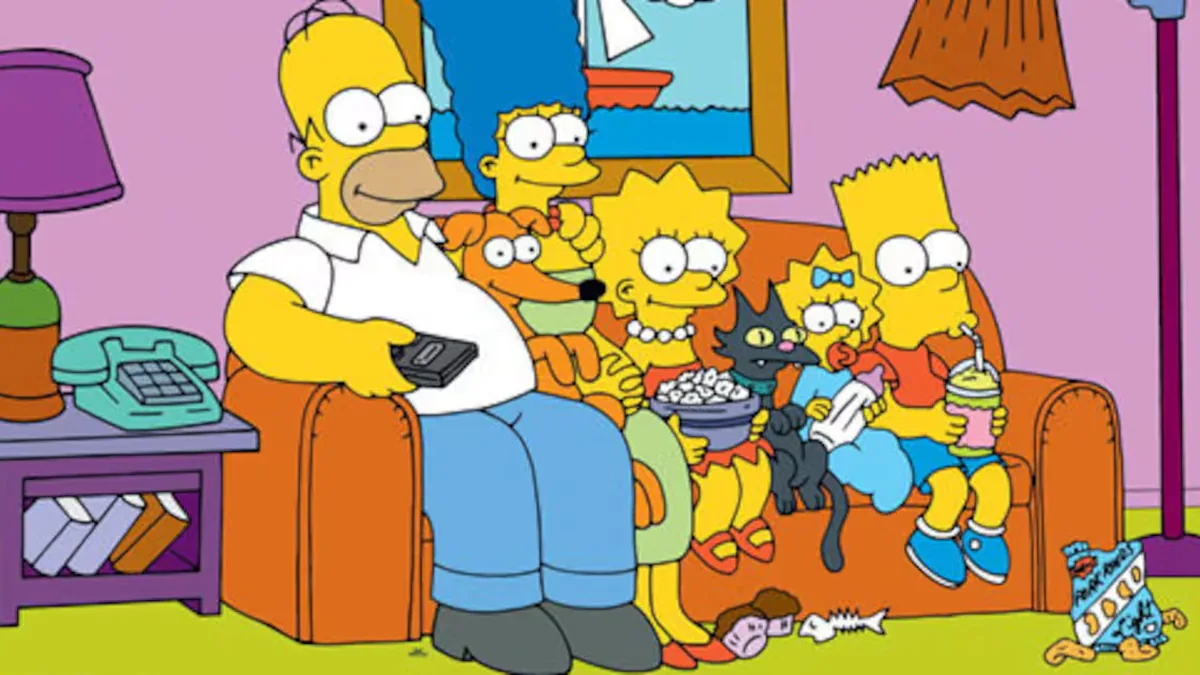
In 2010, Milhouse Van Houten bet that Finnish economist Bengt Holmström would win the Nobel Prize in Economics. Six years later, Holmström received the award. A cartoon boy, whose main life challenge is convincing Lisa Simpson to listen to him, had anticipated a decision by the Royal Swedish Academy of Sciences.
There are consultancies that charge fortunes for far less.
The predictions of The Simpsons have become one of the quirkiest phenomena in contemporary television culture. Whenever something especially unusual happens in the world, someone digs into the Springfield archives and finds a scene suspiciously similar to it. Matt Groening’s series has earned a prophetic reputation that many economists, geopolitical analysts and women who interpret planetary movements would envy.
But how do they do it?
Nearly Four Decades of Forecasting the Future
The Simpsons began their run as a standalone show in December 1989. In February 2026 they officially reached 800 episodes and are currently broadcasting their thirty-eighth season. From Springfield have passed presidents, scientists, entrepreneurs, epidemics, wars, economic crises, technological advances, sports scandals and virtually every known form of human folly.
It is an enormous amount of material.
Imagine a person who, since 1989, had dedicated themselves to writing daily scenarios that could occur in the world. Some reasonable, others extravagant and others directly delirious. We store all those papers in a room and, almost four decades later, select only those that align with real-world events.
We would probably leave that room convinced we had lived with a prophet. Especially if we kept in the room the papers that got absolutely nothing right.
One of the great secrets of The Simpsons’ predictions is that we know their hits, but rarely count their misses.
Al Jean, one of the show’s historic writers, has explained the phenomenon with a simple image: if you throw enough darts, you will eventually hit the target.
And The Simpsons have been throwing darts for almost forty years. At this point, the truly extraordinary thing would be that they hadn’t hit the mark a few times.
The Future Was Already Giving Clues
Perhaps the most famous prediction is the rise of Donald Trump to the presidency of the United States. In March 2000, in the episode Bart to the Future, Lisa Simpson appears as President and alludes to the budgetary problems inherited from her predecessor, President Trump.
Sixteen years later, Trump won the presidency.
Impressive, to be sure. But there is a detail far less known: in October 1999, months before the episode aired, Trump had already formed an exploratory committee to study a possible presidential bid for the Reform Party.
The possibility of a Trump presidency existed in public debate. The writers thought it was a good comedic premise. The American electorate, years later, found it to be a political option.Another particularly amusing case is Disney. In a 1998 episode there was a sign showing the 20th Century Fox studios as a division of the Walt Disney Company. In March 2019 Disney materialized the acquisition of a large portion of 21st Century Fox’s assets.
It turns out Disney had already acquired the group that owned ABC in 1996. Hollywood’s corporate concentration was underway. The writers simply extended that trend to a consequence that then seemed comic.
What in 1998 was a joke about Mickey Mouse’s corporate voracity ended up being a fairly accurate description of its fortune.
A good satire often consists of exaggerating the present until it starts to resemble the future.
The Intelligence Behind Homer Simpson
It is prudent not to undervalue the talent of those who have written the series throughout all these years. The fact that its protagonist struggles to function cognitively in the presence of a household appliance does not mean that the people who created him share those limitations.
In 1995, in a future-set episode, The Simpsons depicted a character communicating via a wristwatch. Today that seems like a forewarning of the Apple Watch. But Dick Tracy already used a wrist radio in his 1946 comic strips.
The idea had circulated for decades. The missing piece was that the technology could be manufactured when the time came.
Matt Selman, executive producer of The Simpsons, explained in a 2024 interview with People that much of its predictive power reduces to two disciplines far less esoteric than some would wish: history and mathematics.
History, because humans have an extraordinary capacity to repeat our behaviors. Mathematics, because the volume of imagined situations by the show increases the odds of coincidences.
A writer who knows well the grinds of politics, bureaucracy, big business and human nature has a considerable edge in imagining what will happen twenty years from now. Especially when a good portion of those who will be protagonists in those events will share the same ambitions and the same flaws as their predecessors.
Phones will change. Mr. Burns will still exist.
Hollywood, the Elites, and Predictive Programming
At this point, it is worth addressing one of the most popular theories found on the internet: that The Simpsons would be used by certain elites to anticipate orchestrated events and to habituate the population to their eventual realization.
This is what some call predictive programming.
There is a portion of this discussion that deserves serious consideration. Hollywood has historically been a formidable instrument of cultural and political influence. The U.S. Department of Defense itself maintains formal mechanisms for collaboration with film and television productions, including everything from counsel during script development to access to military facilities.
The relationship between power and entertainment exists and is well documented (imagine what remains undocumented).
Now, however, to conclude that The Simpsons writers receive insider information about events that a world elite intends to carry out twenty years from now is a substantial intellectual leap.
One thing is studying the use of entertainment as a vehicle of ideology, and another is attributing to a show a specific function for which we do not have proof.
Recognizing the first does not obligate us to accept the second. Precisely because propaganda exists, it is worth studying it with a bit more rigor than a collection of TikTok videos.
Predictions Invented by the Internet
To complicate the matter even further, some of the most spectacular predictions don’t even belong to the series.
The famous scene of Trump descending an escalator, often presented as a prediction for the year 2000, comes from a short film published in July 2015, after the actual event had taken place.
There were also manipulated images that attributed to The Simpsons an explicit prediction of the coronavirus. The original episode, aired in 1993, dealt with a fictional disease called Osaka flu.
With generative artificial intelligence, anyone can also fabricate new Springfield prophecies without Matt Groening signing off on them.
We find ourselves in the curious situation where the internet can today invent a prediction from thirty years ago and present it tomorrow as proof that someone knew our future.
And yet, none of this should diminish the genuine successes of the show. On the contrary. There is something magnificent about a group of writers, armed with culture, intelligence, humor, and a considerable dose of fortune, who managed to imagine so many situations we would later live.
Perhaps the most unsettling thing about The Simpsons is not their ability to predict the future, but how easily we end up turning their jokes into news.
They wrote comedy. Those of us who have taken the script seriously have been ourselves. Because all of this is part of mere conspiracy theories. Or not. Who knows.