
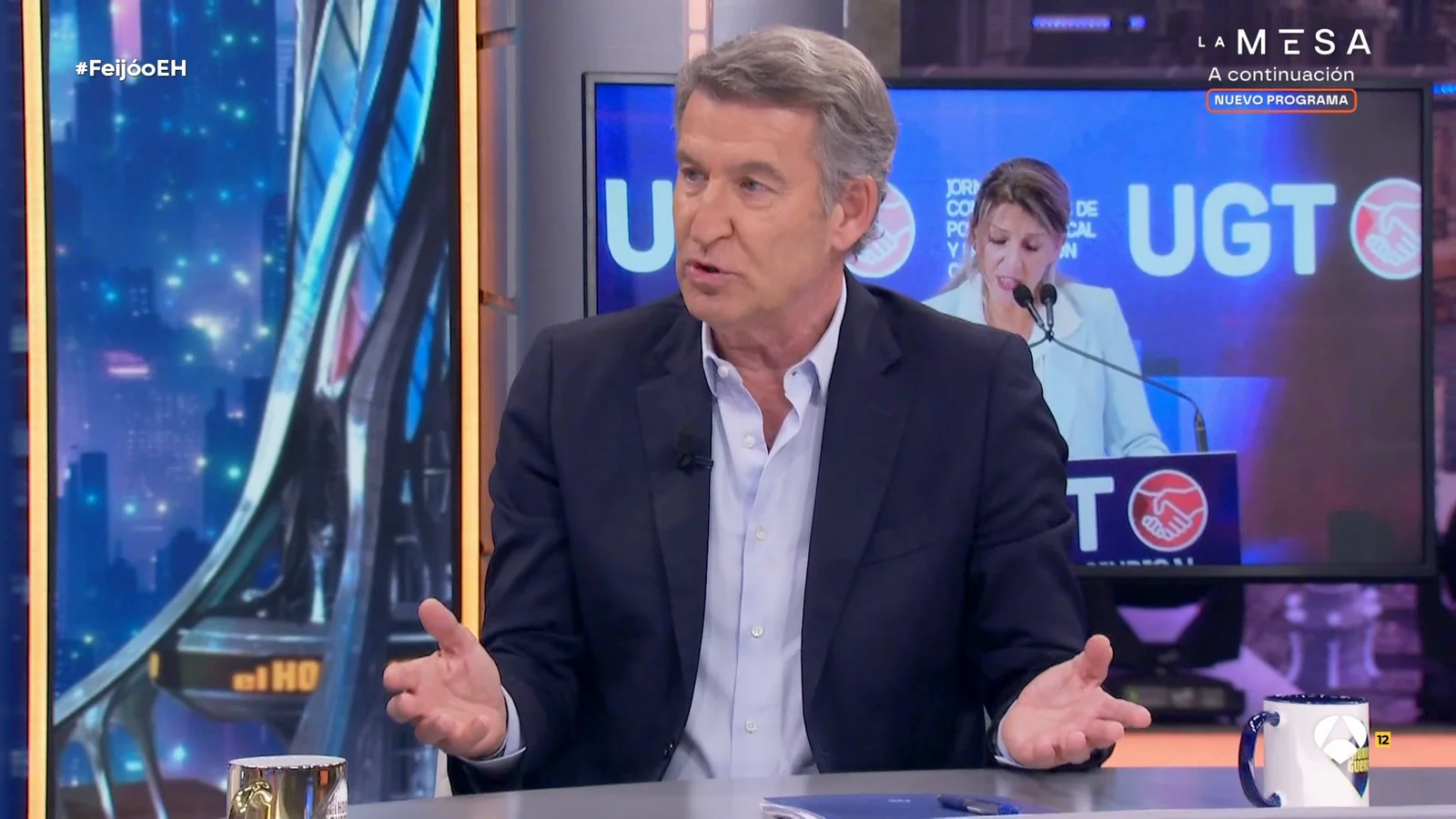
One has to acknowledge that Pablo Motos possesses an extraordinary sense of showmanship. On Wednesday he managed to have Pedro Sánchez perform as the opening act for Alberto Núñez Feijóo without stepping onto the set or realizing he was part of the spectacle. A feat by a true master of the craft.
Before proceeding, a clarification about the headline. I don’t intend to mock Feijóo’s famous slip, that “Anotop… at” with which he attempted to pronounce “Anatomy of a Fraud” in Congress. Laughing from the couch at the verbal stumble of someone who has spent years speaking before cameras, at rallies and under parliamentary pressure is an extraordinarily comfortable pastime. Especially because the couch, as far as I know, has never had to defend a bill.
My nod goes elsewhere. After what happened in recent days with Abascal, Broncano and Jordi Wild, Feijóo has regained a leading role in political conversation. And among the memes circulating online, some reclaim that unforgettable “Anotop” with more complicity than malice, as if the old stumble had become a small humorous badge of identity. Let’s not confuse a meme with a poll, given that Spain already boasts plenty of statistical imagination. Yet I felt like leveraging the joke to dissect a night that, viewed from Génova, must have looked fantastic. An anatomy of the moment, so to speak. And this time, thankfully, with all the syllables in place.
The mechanism was simple. Seconds before welcoming the PP candidate, Motos explained that he had been trying to interview the Prime Minister for over a month and, facing his refusal, listed the questions he would have asked: corruption, immigration, Zapatero, Ábalos, Koldo, Puigdemont, the Sahara, and a collection of topics that would hardly have allowed Sánchez to speak calmly about his favorite series.
I found the questions excellent. Pertinent. Necessary. Some have waited so long for an answer that they should start accruing seniority. Given the situation we find ourselves in and the gravity of the figures involved, one must be forceful.
But then the magic happened.
The questioning of the absent ended and Feijóo entered.
The transition was so well-timed that, had the PP anthem sounded, someone would have had to say: “maintain your composure…”.
And yet, how good it felt.
The Opening Act That Didn’t Show Up
Motos said he didn’t understand Sánchez’s refusal and spoke of political clumsiness or possible fear. Then he produced the list of questions.
And let no one misinterpret me: I share the questions Motos posed. I think it’s superb that the president is required to explain himself. There are questions that have circulated in Spanish politics for too long without answers.
Because there are those who claim that El Hormiguero is a show of fascists. A fascinating accusation. Apparently, criticizing the Government now constitutes an ideological signal. Only for a freak, obviously.
You can criticize Sánchez without being PP. You can also criticize the PP without being socialist. I know. It’s a risky theory, but I trust that one day it will be accepted by the scientific community.
But let’s return to television.
Because the truly clever thing was not the content of the monologue. It was its placement.
Motos didn’t do it after the interview. Nor during a current affairs panel. He did it immediately before introducing Feijóo.
It was like starting a wedding by listing all the flaws of the bride’s former fiancé and, immediately after, asking for applause for the new marriage.
All perfectly legitimate.
Only the master of ceremonies didn’t need to stretch to make the message understood.
Feijóo Enters a Comfort Zone
Then Alberto Núñez Feijóo appeared, and he found himself in an extraordinarily pleasant environment.
Pablo asked. Alberto answered. Pablo listened. Alberto stayed with it. And so on, in a demonstration of civilized coexistence that would have moved the drafters of the Constitution.
After the clash Broncano and Abascal staged, that scene looked like a correspondence exchange between two 19th-century cavaliers.
Feijóo was correct. Calm, orderly, with that Galician serenity that lets him talk about an institutional crisis as if he were discussing the weather. He did very well, really. He defended what needed defending and criticized what needed criticizing.
And Motos let him develop his arguments.
A lot.
So much that, at times, the candidate could begin an answer, lay out his proposals, and return to the initial argument without fear that someone would interrupt in the meantime to question the existence of the subject and the predicate.
What a wonder.
I’m not being ironic. Well, not entirely.
I like that interviewers listen. I think it’s a precious habit that some programs should reclaim before it becomes considered intangible cultural heritage.
But the uncomfortable questions that night carried a surprisingly uncluttered agenda, free of work obligations.
Some did surface, naturally. And let’s not pretend Feijóo went on the show for a massage.
However, the tougher questions seemed to come wrapped in gift wrap. The candidate looked at them, answered, and moved forward with a calm that would have allowed his communications team to catch up with Netflix.
Feijóo didn’t need to deploy grand defensive maneuvers.
It’s hard to stumble when the floor is so well waxed. Although one shouldn’t overdo the waxing, or you’ll glide away without anyone asking anything.
What would @NunezFeijoo deny to Santiago Abascal? #FeijóoEH https://t.co/jPzk0Ltaoy
— El Hormiguero (@El_Hormiguero) November 11, 2026
Pablo Motos, That Champion of Quality Television
I must admit a weakness: I like El Hormiguero.
I find it an extraordinary television product, with production that many international networks would envy, a brilliant team, and a level of execution that should be taught in universities.
And Pablo Motos knows how to conduct interviews. He understands tempo, he knows how to listen, and he has a formidable talent for making guests feel at ease (or uncomfortable).
What perhaps we hadn’t appreciated enough is how far he can go when he sets his mind to it.
Some people think El Hormiguero is a sort of branch of the Partido Popular with a bigger budget for special effects.
Oh, please.
To begin with, programs start on time, the collaborators work in sync, and it doesn’t seem necessary to consult all the regional presidents to decide who sits where.
Besides, Motos has criticized the PP as well. And criticizing the Government a lot doesn’t automatically make someone a member of the opposition.
But it wasn’t necessary to be Sherlock Holmes to notice that that night the cordiality seemed to have a soft spot for the PP candidate.
The interview was so cordial that one could have expected, at any moment, Feijóo to ask if he could come back with a companion.
And indeed, Pablo has an extraordinary quality: he knows how to unsettle when he wants and how to be exquisitely polite when the moment warrants it.
I don’t know his intentions. And I don’t think that, despite everything, ‘El Hormiguero’ is a partisan program. But the staging was, at the very least, curious: a fiercely critical monologue against Sánchez (which I fully support), immediately followed by a very comfortable conversation with Feijóo.
If someone had wanted to construct a favorable electoral introduction for the PP, they would have had difficulty surpassing the timing.
Two Interviews and One Country
The comparison with La Revuelta is inevitable.
Broncano welcomed Abascal with an energy that suggested both had decided to settle all pending issues between left and right there since the French Revolution.
Motos, by contrast, received Feijóo with a kindness that allowed hope in human relations to be restored.
In La Revuelta, the interviewer argued with the politician. In El Hormiguero, the politician could have asked the interviewer to accompany him to collect the Nobel Prize for Concord.
And between both formats lies a middle ground that perhaps science will someday discover.
Because a political interview doesn’t need to resemble a fight for the last croquette at a wedding, but it also doesn’t have to become a reunion of old classmates where everyone fondly remembers times gone by.
You can let the guest speak and then follow up.
It’s a risky technique, I know. But it seems to work in some countries.
It’s also curious that El Hormiguero has limited this round of invitations to the two main presidential contenders. No corresponding interviews with Vox or Frente Amplio have been announced.
It’s perfectly legitimate. Although, from an entertainment perspective, I think it’s a missed opportunity. Especially since on other occasions guests from the four major political parties have attended.
With the extraordinary cast of characters offered by Spanish politics, limiting the lineup to two candidates is like organizing a food fair and allowing only tortilla de patatas and Russian salad.
Very good, both, indeed.
But come on, a few exotic dishes would have provided a lot of spice.
Genova, Do Nothing. Absolutely Nothing.
At the end of the interview, Feijóo had laid out his proposals, Motos had produced a pleasant program, and the viewers had spent a wonderful time in front of the television.
And that’s the part some seem unable to grasp: you can enjoy an interview, agree with much of what is said, and recognize that it was extraordinarily comfortable for the guest.
There is no obligation to become indignant.
Feijóo took advantage of his opportunity, as one would expect. No one expects a candidate to interrupt his own remarks to ask: “Pablo, sorry, don’t you think you’re making me look a little too good?”
That would have been a memorable scene.
Also perhaps the last interview that his campaign manager would arrange before recommending an indefinite vacation.
Maybe he would have welcomed a bit more repregunta. A bit of discomfort. An unexpected bend on a road Feijóo drove almost entirely with cruise control engaged.
But I’m not going to ask them to turn an entertainment program into the State Attorneys’ examinations.
I’ll take away the prodigious architecture of the night.
Pedro Sánchez faced the toughest questions just before Feijóo appeared. Feijóo encountered an extraordinarily cordial conversation just after the questions to Sánchez ended.
Everything in its place.
Everything perfectly synchronized.
And with televisual elegance truly admirable.
If I were the PP, I’d start ordering a Christmas basket for Pablo Motos. Something discreet, courteous, without grand extravagances. A little ham, a decent bottle, and, above all, lots of soft nougat, which seems to have been the specialty of the night.
Although, upon reflection, perhaps it’s better not to send anything. As Spanish politics stands, you start by gifting polvorones and end up appearing before a committee of inquiry to explain where the almond came from.