
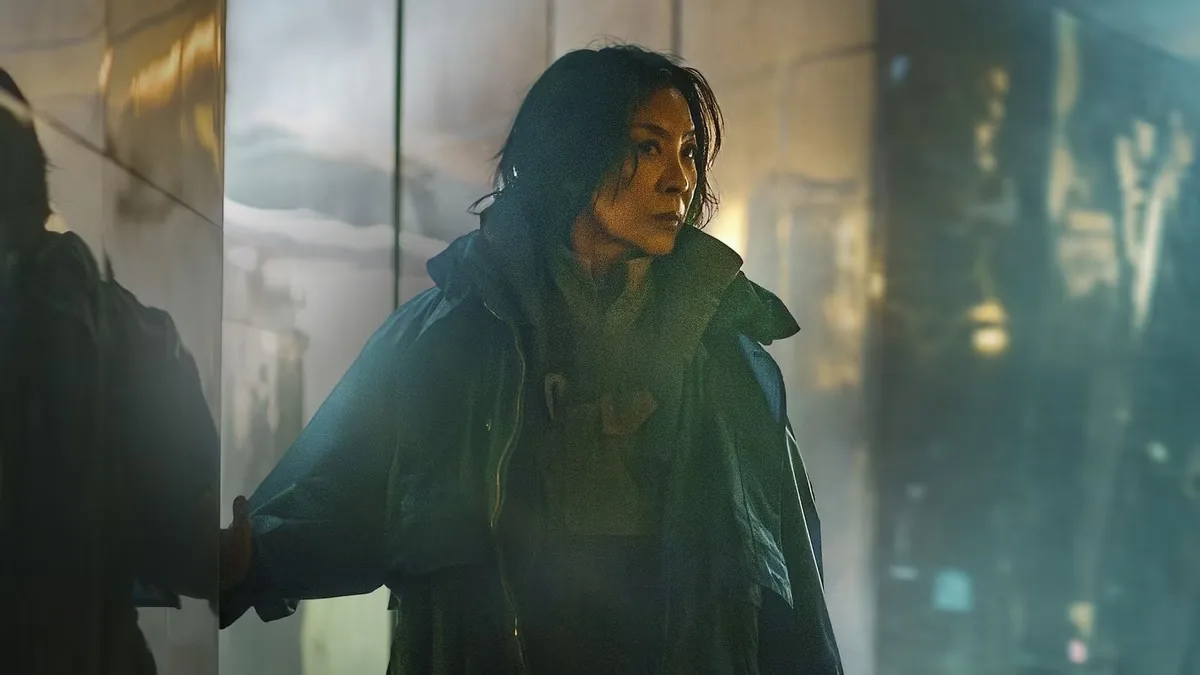
Fifty years separate Blade Runner 2099 from Blade Runner 2049, not in our calendars, but within the fiction. Denis Villeneuve’s film premiered in 2017; the new miniseries will arrive on Prime Video on November 25, 2026. Its title signals a leap to the year 2099, enough to make the Los Angeles of the replicants a different place and to ensure the story does not depend on reviving the protagonists from the films.
Amazon has confirmed eight episodes, released all at once, led by Michelle Yeoh and Hunter Schafer. The premise described in Prime Video’s official information speaks of a rebuilt city, though not by humanity, and of an alliance between a fugitive and a dying replicant. The trailer was unveiled at New York Comic Con on October 10.
The news is the launch of a series within a well-known franchise. The interesting story is what has to change so that Blade Runner continues asking the same questions without merely reproducing its most iconic images. The new format offers more room for the characters, but it also requires sustaining across eight episodes a universe whose cinematic power depended as much on what it suggested as on what it explained.
From the 2019 future to 2099: eighty years to change the rules
The original Blade Runner, directed by Ridley Scott and released in 1982, set its story in a Los Angeles imagined for 2019. Blade Runner 2049, directed by Denis Villeneuve and released in 2017, moved the action thirty years forward within that world. 2099 now extends the chronology by another fifty years. They are, therefore, eighty years of fictional history since the setting of the first film, not eighty years of film productions.
| Production | Year of release | Fictional era |
|---|---|---|
| Blade Runner | 1982 | 2019 |
| Blade Runner: Black Lotus (animated) | 2021 | 2032 |
| Blade Runner 2049 | 2017 | 2049 |
| Blade Runner 2099 | 2026, planned | 2099 |
The chronology also avoids a common misconception: this will not be the first Blade Runner TV series. In 2021, the anime Blade Runner: Black Lotus, set in 2032 and distributed by Adult Swim and Crunchyroll, premiered. Its existence is listed in Alcon Entertainment’s dossier, the company tied to the franchise. The novelty of 2099 lies in betting on a live-action miniseries that continues the chronology beyond Villeneuve’s film.
This leap has a narrative advantage: it allows showing the consequences of tensions already present in that universe without requiring every character or conflict to return. It also poses a risk. The more the context is transformed, the more the fiction must justify why that future remains recognizably Blade Runner.
A fugitive, a dying replicant, and the question of who’s chasing whom
Hunter Schafer plays Cora, a fugitive who assumes one final identity: that of a blade runner. Her mission forces her to join forces with Olwen, a replicant portrayed by Michelle Yeoh who has only a few days left to live. Together they must pursue someone who hides a truth capable of destabilizing the city, according to Prime Video’s synopsis.
It is a pursuit premise, but it contains a contradiction at the core of the saga. In Scott’s film, replicants were artificial beings hunted by agents tasked with “retiring” them. In the sequel, the blade runner’s investigation remained threaded with questions of memory, origin, and the capacity to decide. Now a replicant’s survival is tied to the work of a hunter who, in turn, is trying to stop running.
We do not yet know how the series will resolve that relationship or what social structure has emerged in 2099. The idea that Los Angeles has not been rebuilt by humans is a stated starting point, not proof that the fiction presents a definitive political order. It will be the course of the episodes that explains who controls the city and what place the replicants occupy.
The biggest challenge is not reclaiming the aesthetics, but finding another perspective
Blade Runner has a visual repertoire so instantly identifiable that you can recognize it before knowing the story: nighttime streets, oversized advertisements, oppressive architecture, and a city that seems to live constantly under the influence of hidden economic powers. Reproducing those images could offer an immediate reunion for viewers. It would not, on its own, prove that the new fiction has something new to tell.
The first film posed an awkward question: what distinguishes a person from a manufactured creature. Villeneuve’s film added another concern: whether an identity built from memories can generate authentic emotions and decisions. Nearly a decade after that sequel, a miniseries has the opportunity to look not only at individual cases but at the institutions and relationships that have grown around those questions. It is a possibility of the format, not a guaranteed outcome before the premiere.
The creative lead for Blade Runner 2099 is Silka Luisa, known for Shining Girls. Ridley Scott serves as an executive producer, while Jonathan van Tulleken directs the first two episodes. The series is not directed by Scott or Villeneuve. ActualTV has already analyzed Scott’s stance and his relationship with franchise control; here the question is strictly creative: how to consolidate a distinct voice within a universe whose aesthetics have influenced a large portion of later science fiction.
Eight episodes to resolve a tension that cinema kept open
Prime Video has presented Blade Runner 2099 as an eight-episode miniseries that will be available starting November 25. Its all-at-once release favors continuous viewing, but leaves intact the underlying question: whether a story like this succeeds in spending hours explaining how its world operates, or if it loses some of the ambiguity that defined the films.
Cult sci‑fi can also become television without needing to reproduce every one of its conventions. The very existence of Black Lotus shows that the franchise had already experimented with other forms of storytelling. The decisive thing will be to see whether the new production finds a distinctive dramatic tension in the relationship between Cora and Olwen, and whether the leap to 2099 yields credible consequences for a city that has spent decades imagining possible futures.
Until its premiere, the conclusion cannot be that Blade Runner has found a new identity. What can be stated is that Prime Video has chosen a path more demanding than a mere continuation: shifting half a century of its fictional world, changing the protagonists, and entrusting the narration to a different creative team. Therein lies both the possibility of renewing the saga and the risk that the future ends up looking too much like its past.