
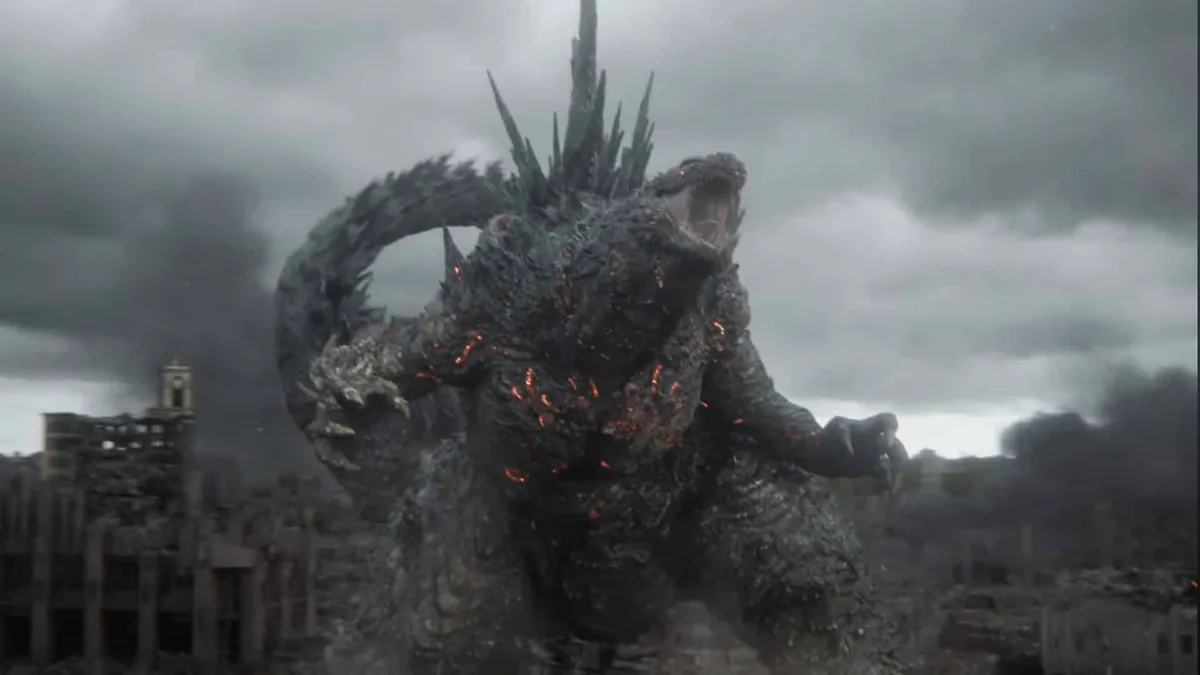
Godzilla Minus Zero is part of one of the most daring decisions in Godzilla Minus One: to present a real victory, but not a definitive one. The Takashi Yamazaki film closed the assault on the monster and allowed its characters to imagine a different future, though the last underwater image left a concrete threat: a fragment of Godzilla began to regenerate.
The new movie picks up that thread and places the action in 1949, two years after the events of Minus One. The promo already warns that the protagonists did not completely destroy Godzilla, but it has not yet explained all the details of its recovery. That nuance is important: the sequel does not need to invent a resurrection, although it must demonstrate that it has something new to tell.
The ending of Minus One wasn’t just a surprising twist
The underwater scene works because it does not erase what happened during the finale. Shikishima and the rest of the survivors manage to halt the attack, and the protagonist manages to save himself thanks to Tachibana’s ejector system. The film does not turn that operation into a failure: the lives at risk are saved and Godzilla is left destroyed in appearance.
What changes is the duration of that victory. The monster has been defeated as an immediate threat, but not necessarily as an organism capable of returning. The regeneration turns the ending into a warning about the limits of the solution achieved, not in a negation of the characters’ sacrifice.
That is why Minus Zero faces a narrative problem more complex than simply facing Godzilla again with another blast. The first film already showed that destructive force can be enough to slow him down, but not to guarantee that every remnant of his body has disappeared.
The sequel must avoid repeating the same movie
The most evident risk is that the continuation reduces its premise to an expanded version of the previous battle: Godzilla returns, Tokyo is once again in danger, and the characters seek an even more spectacular plan. The final hint allows for something more interesting, because it shifts the question from how to defeat the monster to what it means to have believed that the threat was resolved.
That change also affects the scale of the story. Godzilla Minus One used the kaiju to speak about a Japanese society scarred by war, loss, and the difficulty of starting anew. The sequel brings back the Shikishima family, so the conflict does not originate solely from an external catastrophe: it will also have to show what remains of a life that was just beginning to rebuild.
The setting in 1949 offers a sufficient time gap for the consequences not to be immediate. It is not about a consecutive appearance with no space between one film and another, but a leap that allows us to consider how the characters’ lives have changed and what would have happened if the danger had remained hidden for an extended period.
What the promo confirms and what remains open
The promotional material for Godzilla Minus Zero includes a warning attributed to Noda: «we did not manage to destroy Godzilla completely». The line directly connects with the fragment regenerating in the depths and confirms that the sequel’s continuity stems from the ending of the previous film.
That does not yet allow us to state how long Godzilla took to rebuild, what state it was in during that time or whether the sequel will offer a detailed biological explanation. The film may rely on a capacity already shown by the monster without meaning that all the steps of its recovery are publicly explained.
The gap between what is confirmed and what remains unknown is particularly relevant in a franchise accustomed to reappearances. In this case, the interest is not only in knowing whether Godzilla returns, something the premise itself takes for granted, but in knowing what consequences it has for those who thought they had closed that chapter.
A story of survival after survival
The sequel’s great asset may lie precisely in not treating regeneration as a final trick. If the monster retains tissue able to rebuild itself, the problem ceases to be purely military. The challenge is to discover how to confront a threat that does not disappear even when its visible form is destroyed.
That approach allows Minus Zero to preserve the human dimension of its predecessor. Shikishima does not have to prove again that he is willing to sacrifice; he has already passed that point. Now the film can explore what happens when surviving does not equate to having left behind what caused the trauma.
It also changes the relationship between the characters and Godzilla. In Minus One, the monster was a devastating presence that intruded upon a weakened society. In the new story, the protagonists begin from a knowledge they did not have before: they know that destroying the creature’s body is not enough. That information should alter their decisions, their priorities and the way they understand danger.
Release date in Spain
Godzilla Minus Zero will hit Spanish cinemas on November 6, according to available information about its release. The date positions the film as one of the major bets of fantasy cinema in the final stretch of the year and will allow us to see whether the sequel transforms the final hint from Minus One into a narrative evolution or merely into the starting point for another confrontation.
The film, therefore, does not have to surpass its predecessor merely with a bigger creature or more spectacular destruction. Its true test is to justify why that incomplete victory deserved to continue and to show what price it has for a family that believed they had finally recovered the possibility of living in peace.