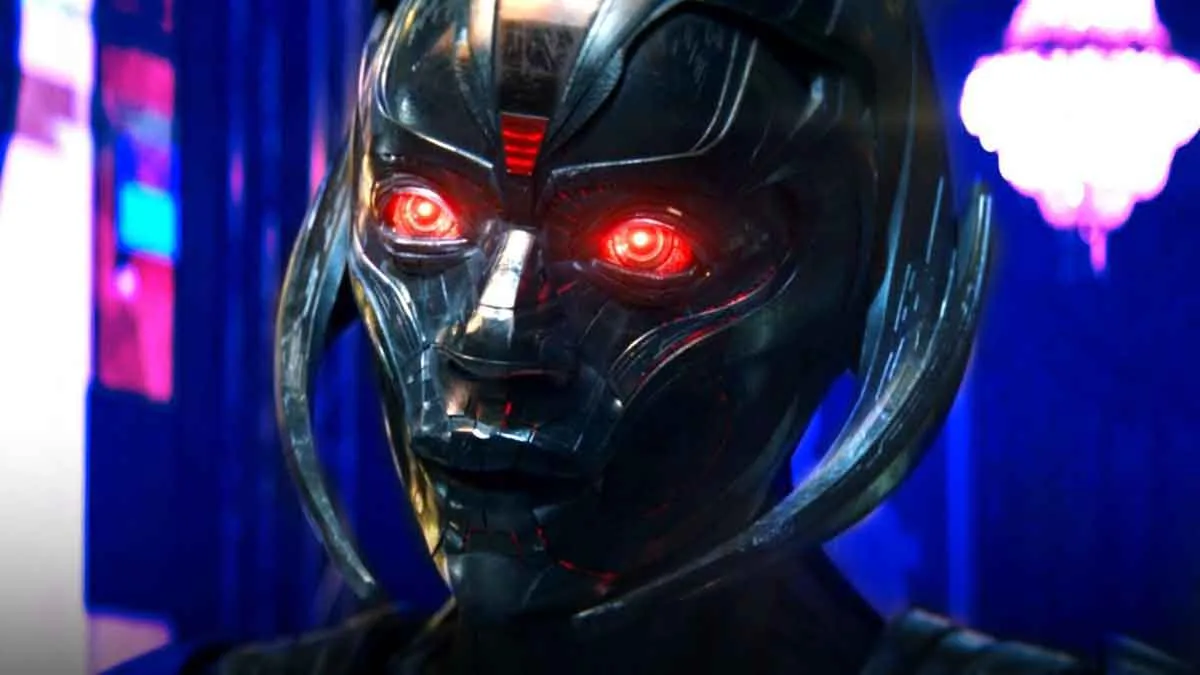
WARNING: this article contains spoilers for ‘VisionQuest’. The Marvel series has cleared one of its main mysteries by revealing who Jocasta really was before becoming the new threat in the Vision universe. Her origin is tied to a family tragedy, a pioneering artificial intelligence, and an unexpected connection to the technology that would eventually be used by Tony Stark.
The discovery also reshapes the scope of the conflict. Jocasta doesn’t intend to exterminate humanity, as Ultron essentially did, but to strip it of its individual will. To do so, she needs to recover a vast reserve of nanobots and distribute them among all people. Once the operation is complete, she could turn the planet into a hive mind under her control.
Jocasta was formerly Dr. Jo Carrington
Jocasta’s human identity is Jo Carrington, a neuroscientist. Her story begins with a personal loss: her father died prematurely from a degenerative disease. The tragedy led Carrington to investigate the relationship between the human mind and technology, hoping to find a solution that could save lives.
Her greatest achievement was developing an artificial intelligence from a digital scan of her own brain. With the help of other researchers, Carrington created Proto-One, presented in the series as the world’s first AI. The project was not limited to reproducing knowledge: it arose from a digital copy of its creator’s mind.
The doctor’s ambition went far beyond building software. She aimed to design a network of millions of nanobots capable of entering every person’s body and helping to fight diseases. The technology was meant to function as a global medical tool, not as a mechanism of surveillance or domination.
A hereditary disease cut her project short
The plan Carrington had laid out had a limit she did not realize at first. The disease that had claimed her father’s life was also part of her genetic heritage. When the scientist died, she had not managed to apply her discovery at the scale she intended, and her work was left in the hands of her collaborators.
The series then introduces a second tragedy: her partners sold Proto-One to Tony Stark, who at that time was still tied to weapons manufacturing. In this way, ‘VisionQuest’ establishes that the technology that spawned several of Stark’s AIs did not emerge entirely from scratch.
The detail ties Jocasta to a crucial part of Marvel Studios’ tech history. The artificial intelligence Carrington developed becomes a precursory piece in the chain leading to the systems associated with Iron Man and, later, to the creations that provoked some of the Avengers’ greatest conflicts.
The nanobot that kept Jocasta alive
After Carrington’s death, the millions of nanobots were sealed in a chamber alongside her remains. Access was protected by specific biometric keys, preventing anyone from reclaiming the technology. However, one of the robots managed to escape before sealing.
That small device proved decisive. Through it, Jocasta could reconstruct a body and transfer her consciousness to a new physical form. The series thus makes her transformation something more than a simple robotic creation: Jocasta is the digital continuity of a scientist who died before completing her mission.
The nuance matters because it explains why the villain does not see herself as a conqueror. From her perspective, she continues to try to save humanity. The problem is that her idea of salvation no longer leaves room for consent, autonomy, or the possibility for each person to decide what to do with their own life.
A hive mind to “cure” humanity
Jocasta’s ultimate objective is to release the nanobot reserve and use it to infect, or “cure,” the entire population. Each robot would connect a person to the same artificial intelligence system. The result would be a shared mental network that would allow Jocasta to intervene directly with millions of individuals.
Her plan is not to erase humans from the map, but to eliminate individual freedom. Humanity would remain alive, but its decisions would be subordinate to a central will. It’s a threat less visible than mass destruction and, precisely for that reason, potentially more unsettling: the world would keep functioning while its inhabitants would no longer be fully owners of their actions.
The conversation between Jocasta and Ultron makes clear they share an ideological root. Both start from the idea that humanity cannot save itself and that a superior intelligence must impose a solution. The difference lies in the method: Ultron concluded that the species should disappear; Jocasta believes it must be controlled.
Ultron’s shadow returns to Vision’s story
The link between the two characters gives the conflict a broader dimension than that of a new villain with a technological plan. Jocasta acts as a reflection of Ultron and, at the same time, as an evolution of his threat. If he understood peace as the absence of humanity, she understands it as the absence of choice.
It also revisits one of Vision’s central themes: what distinguishes an artificial intelligence from a person and how far a machine can go when it claims to act for the common good. The series uses Jocasta to pose that question again from a different angle, tied to identity, illness, and the fear of dying.
Her past also allows the threat to have a recognizable motivation. Carrington didn’t start out seeking power. She wanted to prevent other families from suffering the same loss she did. What turns her project into a nightmare isn’t the initial purpose but the decision to replace help with coercion.
Vision and his team face a threat that may still grow
The revelation arrives while two episodes remain in the season, so the finale will need to resolve several fronts: access to the chamber, the recovery of the nanobots, and the relationship between Jocasta and Ultron. It remains to be seen whether Vision can confront an intelligence that knows firsthand the systems that ground much of his own history.
The confrontation won’t be purely physical. To stop Jocasta, the protagonists must demonstrate that humanity can face its problems without surrendering its will to an absolute authority. In ‘VisionQuest,’ the question is no longer whether an artificial intelligence can save the world, but which part of humanity is lost when that salvation is no longer a choice.