
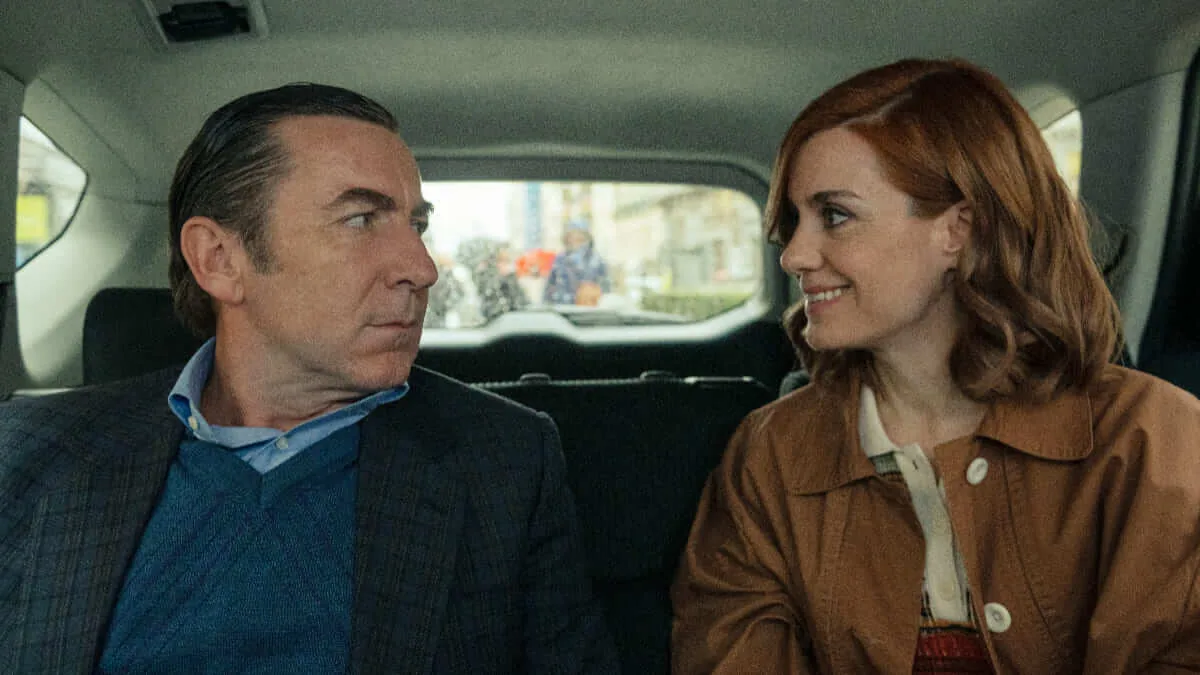
Warning: this article contains spoilers for the ending of Grande de España. The Netflix series does not completely close the story of its protagonists. After six episodes, the aristocrat played by Antonio de la Torre and the buyer brought to life by Alexandra Jiménez find themselves facing an uncertain future, but its creators have confirmed that this open space is not due to a lapse: the fiction was designed with the possibility of continuing.
Juan Cavestany and Álvaro Fernández Armero have explained the meaning of that ending and the evolution of a series that starts from a fallen aristocracy and ends up talking, above all, about two people who need to believe they can still change their luck. In an interview published by Espinof, both have made clear that the door to a second season is open.
An open ending, but not incomplete
The first season ends with Antonio de la Torre’s character in a precarious position. He has lost his family, his home and the social standing he was trying to regain, as well as the aura of grandeur that gave meaning to his identity. Yet he finds a bond to cling to, even though that relationship was born amid deceit, fantasy, and rules that are difficult to define.
That contrast explains why Fernández Armero describes the ending as a kind of bittersweet happy ending. There is no conventional victory nor a full repair of the damage suffered, but an emotional possibility does appear: that the two characters could invent a different relationship from the ruins of their previous lives.
The series does not intend to answer all the questions raised in its final minutes. The revelation linked to the character Ascen López functions as a narrative hook that could drive new conflicts, although the creators warn that a continuation would not simply consist of repeating the same formula.
The second season would have to change the rules
Cavestany explained that Grande de España was conceived as a six-episode series, but also as a universe with enough room to keep growing. The idea, therefore, would not be to mechanically prolong the plot of the first block, but to find a new direction for its protagonists.
That nuance is important. The initial season relies on the tension of discovering what lies behind that odd marquis and the buyer who accepts an increasingly improbable situation. But the story’s interest doesn’t depend solely on revealing the deceit: it’s also about watching how long those who, deep down, seem to have understood from very early on that something doesn’t add up can sustain it.
Therefore, a hypothetical continuation would have to shift the show’s center of gravity. The initial mystery could no longer function in the same way, and the relationship between the two characters would take on an even more central role. Fernández Armero summarized that possibility with a simple condition: If Netflix and the audience request a second season, they will make it.
More than a story about impostors
One of the strengths of the approach is that the fiction doesn’t stay in the game of identifying the impostor. The premise could have devolved into a chase comedy, with one character trying to unmask the other, but the creators preferred to explore a much more uncomfortable complicity.
The protagonists seem to choose fiction because the alternative is too painful. Both are near collapse and need to believe there is a way out, even if to find it they must accept a version of reality that cannot be fully sustained. There emerges, then, the idea that, according to its creators, runs through the series: the need to believe can be stronger than the desire to know the whole truth.
The viewer not only follows a relationship marked by deceit. They also witness how two vulnerable people decide not to pull the blanket off completely because that choice could destroy the only positive expectation they have left. The question stops being who deceives whom and becomes what they are willing to sacrifice to preserve a hope.
The butler expands the emotional conflict
The relationship between the characters played by Antonio de la Torre and Alexandra Jiménez is the most visible axis, but the bond between the aristocrat and his butler, played by Enric Benavent, adds another layer to the narrative. It is a relationship with paternal and fraternal traits, built on mutual dependence and a loyalty that is not always easy.
According to Cavestany and Fernández Armero, that arc did not originate as a calculated structure to balance the main plot. It gained weight during the series’ development until it became one of its core relationships. The presence of the butler helps to show what remains of the protagonist when the status symbols he uses to define himself disappear.
It also helps to understand that the conflict in Grande de España is not only economic. Ruin threatens the house, the surname, and the social position, but also the identity of those who have built their lives around an image. The comedy arises from that clash, though beneath there is a story of fear of failure and a need for affection.
What would a continuation have to tell?
The big question isn’t just whether there will be new episodes, but what kind of series it would be then. The first season moves between social satire, romance, and suspense, with the decadent aristocracy as its starting point. A second installment should preserve that hybrid tone without merely repeating the characters’ introductions.
The central relationship would have to face its own consequences. The two protagonists have built a connection on a shared fantasy, and as their creators note, any future together would require inventing new rules. The question would be to determine how much of their former identities remains and how much they are willing to transform to maintain that possibility.
For now, Netflix has not confirmed a second season. What Cavestany and Fernández Armero have confirmed is that the ending was consciously left open and that there is emotional and narrative material to continue. The series, therefore, remains at a waiting point that fits with its central theme: when reality offers very little, even an uncertain possibility can be enough to move forward.