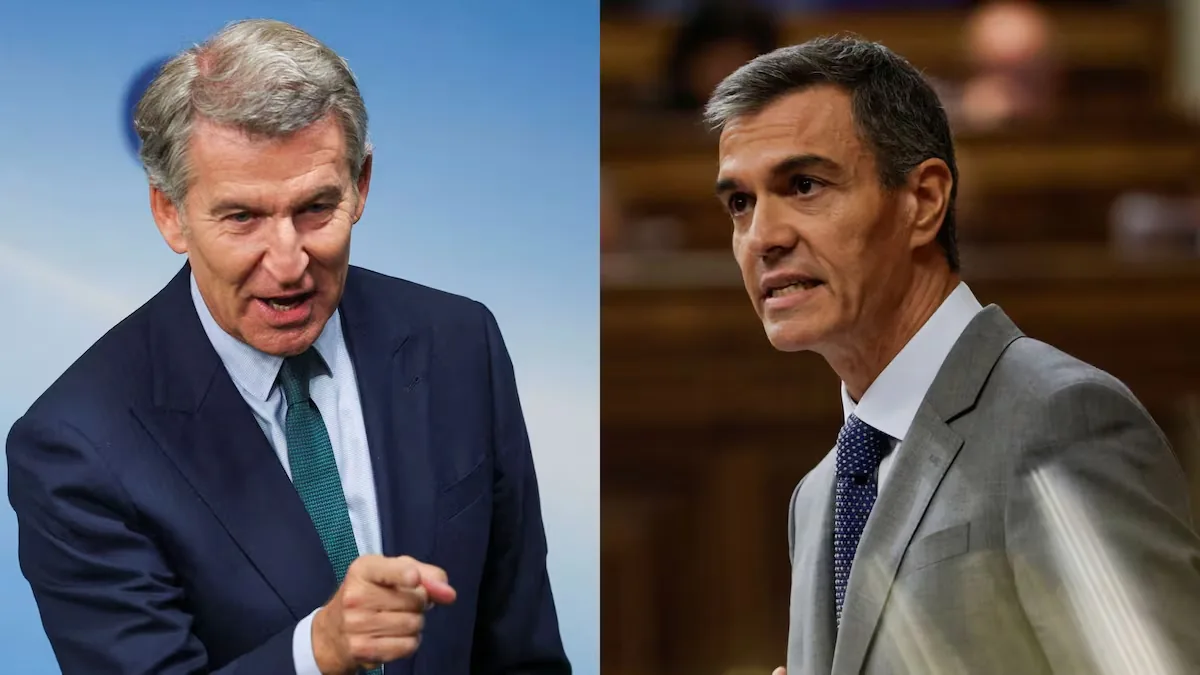
The People’s Party currently does not accept the four-way debate proposed by RTVE and designates Atresmedia as its preferred option for the face-off between Alberto Núñez Feijóo and Pedro Sánchez. The dispute affects not only the chosen network: it also keeps open the dates, the number of participants, and the format of the campaign debates for the general elections on November 29.
Sources from the PP’s national leadership told Servimedia that the party will not attend the four-way debate on the public TV that the PSOE has accepted. The Popular Party has, however, shown willingness to participate in the debate of parliamentary spokespeople proposed by RTVE, a different event from the one that would bring together the main candidates.
What each network aims to organize
The problem arises from the overlap of several broadcasting options that do not share a calendar or lineup. The networks have proposed different combinations of debates, but the parties still must decide which proposals they will accept and under what conditions.
- Atresmedia proposed a one-on-one between Sánchez and Feijóo on November 23 and a four-way debate on November 18.
- RTVE proposed a one-on-one on November 17, a spokesperson debate on November 23, and a four-way debate on November 26.
- Mediaset put on the table a one-on-one on November 16.
- La Séptima, which plans to begin broadcasting on November 5, offered a face-to-face and thematic debates with open signal for other media.
These dates represent the networks’ proposals, not a fixed timetable of debates. The parties’ positions also bring changes to the initial plan, which is why November 16, 23, and 26 appear linked to different formats and broadcasters depending on who makes the offer.
The PP’s Position: Atresmedia for the Face-off
The PP wants the direct confrontation between Feijóo and Sánchez to take place on Atresmedia. The party has also proposed that the debate scheduled for November 26 be broadcast on Mediaset, although this distribution is part of its political proposal and not a final agreement among all parties.
The Popular Party rejects holding the four-way debate on RTVE, even though the PSOE has expressed willingness to participate in that format. The PP leadership argues that Atresmedia should not be excluded from the main debate and believes the private network should play a central role in election coverage.
The party does, however, accept attending the RTVE parliamentary spokesperson debate scheduled for November 23. That format does not pit only the candidates most likely to preside over the government against each other, but expands representation to parties with parliamentary presence.
The PSOE calls for the involvement of public television
The PSOE has confirmed its willingness to participate in a televised face-off between Sánchez and Feijóo on November 16 on a private network. At the same time, it argues that RTVE should not be left out of the debates and supports that the four-way debate be held on public television.
The Socialist position, as conveyed in these negotiations, does not imply vetoing private networks. Their demand is that the public broadcaster also organizes one of the main events and that media outlets be allowed to take charge of organizing the debates.
Therefore, agreeing to a face-off on a private channel does not resolve the fundamental disagreement. The sticking point remains the four-way debate: the PSOE accepts RTVE’s proposal, while the PP wants to change both the broadcaster and the date distribution.
Three formats that should not be confused
The negotiations are especially confusing because three distinct debates are being discussed. Each has a different lineup and a different television function for the viewer.
Face-to-face
Brings together Pedro Sánchez and Alberto Núñez Feijóo, the PSOE and PP candidates. It is the most prominent format for both leaders and concentrates attention on their proposals, their responses, and their ability to engage in direct confrontation.
Four-way debate
Expands the scene to four candidates. Its exact composition depends on the invitation and the agreed criteria for determining which formations participate, so it should not be confused with the bilateral clash between the leaders of the two major parties.
Spokespersons’ debate
RTVE’s proposal includes the parliamentary spokespersons from PP, PSOE, Vox, Sumar, ERC, Junts, EH Bildu, and PNV. It is a broader formula than the four-way debate and, according to the PP’s known position, is the format of the public broadcaster that does have its backing.
A calendar pending closure
The electoral call for November 29 requires fitting the debates into the preceding weeks, but the current offers overlap. The date of November 16 is linked to the face-off that the PSOE accepts and to Mediaset’s proposal, while the PP wants that appointment moved to Atresmedia.
November 23 appears in Atresmedia’s offer for the face-to-face and in RTVE’s for the spokesperson debate. Meanwhile, November 26 is RTVE’s proposed date for the four-way debate, though the PP links it to a Mediaset debate.
The result is that there is still no single calendar that can confirm which network will air each debate. Until the PSOE and PP finalize their commitments, the dates should be read as a combination of corporate offers and party positions, not as definitively confirmed appointments.
The campaign, therefore, will first have to resolve a television issue that will determine candidates’ visibility: who organizes each debate, which leaders participate and on what date it is broadcast. The agreement on these three elements will determine whether coverage is spread across several networks or whether there is an open contest for the central election debate.