
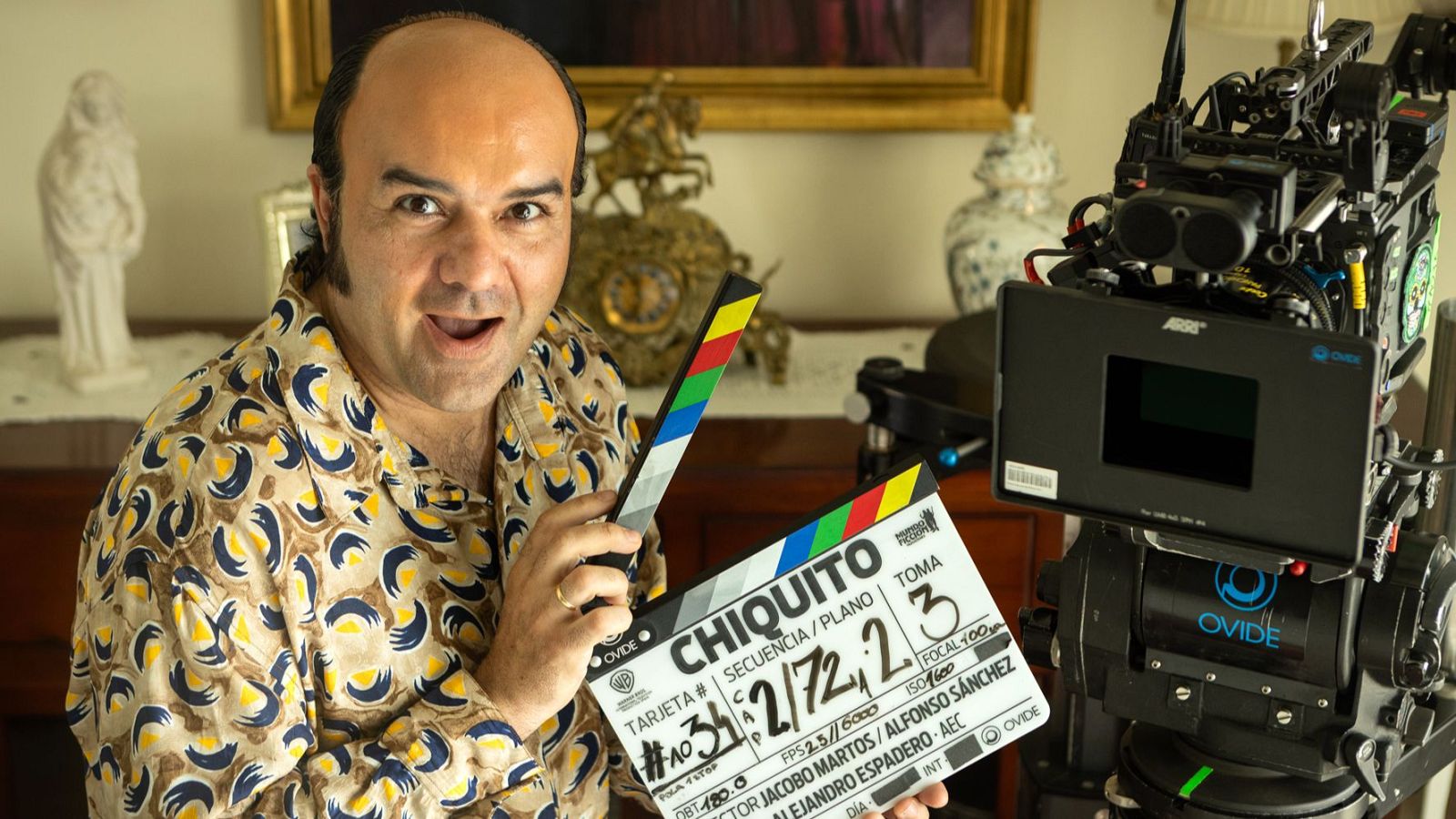
Chiquito de la Calzada was a television phenomenon so recognizable that his life risks being reduced to four invented words and an almost impossible way of walking. The miniseries Chiquito el Grande, which RTVE is preparing for 2027, offers another entry: recounting the decades in which Gregorio Sánchez Fernández had not yet become the character that all of Spain knew. The challenge is not to imitate the jokes, but to explain where a form of humor came from that reached the general public after the age of 60.
The project is not new: RTVE announced it on July 30, when filming began. The novelty on October 18 is the account of completed filming published by EL PAÍS: eight weeks of work in Andalusia, Pepita’s central role in the story, and a reconstruction that travels from the postwar era to television success. There is no precise premiere date announced within 2027.
The Chiquito Before “Genio y Figura”
Most viewers remember his television breakout in 1994. Yet before that moment there was a boy who sang to help support his family, a youth marked by the postwar years, and a career as a flamenco cantaor on stages far from a TV studio. Chiquito el Grande precisely presents this gap between the artist’s age and the age of his fame.
Alfonso Sánchez plays Gregorio Sánchez Fernández and, in addition, shares directing duties with Jacobo Martos. He also participates in the screenplay and production. That accumulation of responsibilities does not guarantee a better biography, but it does indicate that the performance was not designed as a simple characterization assigned to a famous actor. The fiction aims to connect the years of learning with the character who ultimately invented a popular vocabulary.
The announced structure is two 90-minute episodes. They total three hours to cover more than six decades, so the selection of events will be as important as the physical likeness. A series like this must decide which episodes explain a personality and which would merely be a parade of recognizable anecdotes.
Pepita Does Not Appear as a Secondary Character
Inma Cuevas plays Pepita, Chiquito’s wife. The available information about the miniseries places their relationship at the heart of the narrative. It is a decision with narrative consequences: the viewer will not only see the transformation of a cantaor into a television star, but the continuity of a couple through periods of scarcity, travel, and rising popularity.
The choice also allows escaping a common problem in biopics of comedians: replaying the moments when everyone laughed, without explaining what happened when the lights went out. In this case, everyday life and the bond with Pepita can provide unity to decades that, otherwise, would appear as separate chapters.
The announced cast includes Alberto López, Carlos Bardem, Jesús Carmona, Antonio Dechent, Carmen Avilés, Joaquín Núñez, Mari Paz Sayago and Leonor Lavado. RTVE has confirmed that the production recreates locations in Málaga, the Torremolinos tablaos, and the 1990s television atmosphere.
The Challenge of Recreating Andalusia Without Turning It into a Decor
The miniseries was shot in Málaga and Seville, in addition to using RTVE’s Andalusian production hub. According to the Sunday report, the crew worked across about 70 locations with a cast of around 50 performers. Those are production figures provided by the producers, not audience data or indicators of future success.
Recreating the Costa del Sol from several decades ago requires more than old cars and period costumes. It is necessary to find spaces that still allow one to imagine the landscape of the tablaos and the everyday life before mass tourism. The visual challenge is significant because the Andalusia where Chiquito formed is not identical to the one later associated with his television persona.
The choice of a predominantly Andalusian crew, highlighted by RTVE, fits with the aim of rooting the story in a specific territory. But the result will depend on what appears on screen: production announcements reveal intent, but do not yet certify its dramatic effectiveness.
A Biography Different from the Documentary and the Tribute
Chiquito has already been the subject of retrospective programs and documentaries. ActualTV, for example, reported on the documentary that revisits the television conflict around “El otro Chiquito.” That story examines a specific episode of his media legacy. RTVE’s new fiction pursues something else: to build a dramatic character that can engage even someone who did not experience his surge in popularity.
There is a particularly interesting tension. Chiquito’s expressions survive as clips, imitations, and digital references; a three-hour miniseries requires the viewer to stay engaged before those jokes appear. If it works, its great discovery will be that the character who seemed to be born on television had been preparing for decades.
For now, the format, the main cast, the people in charge, and the 2027 release horizon are confirmed. No air date has been announced, nor is there an official trailer for the fiction. It is worth distinguishing the anticipation of seeing Alfonso Sánchez become Chiquito from the evaluation of a series that the public has not yet been able to watch.