
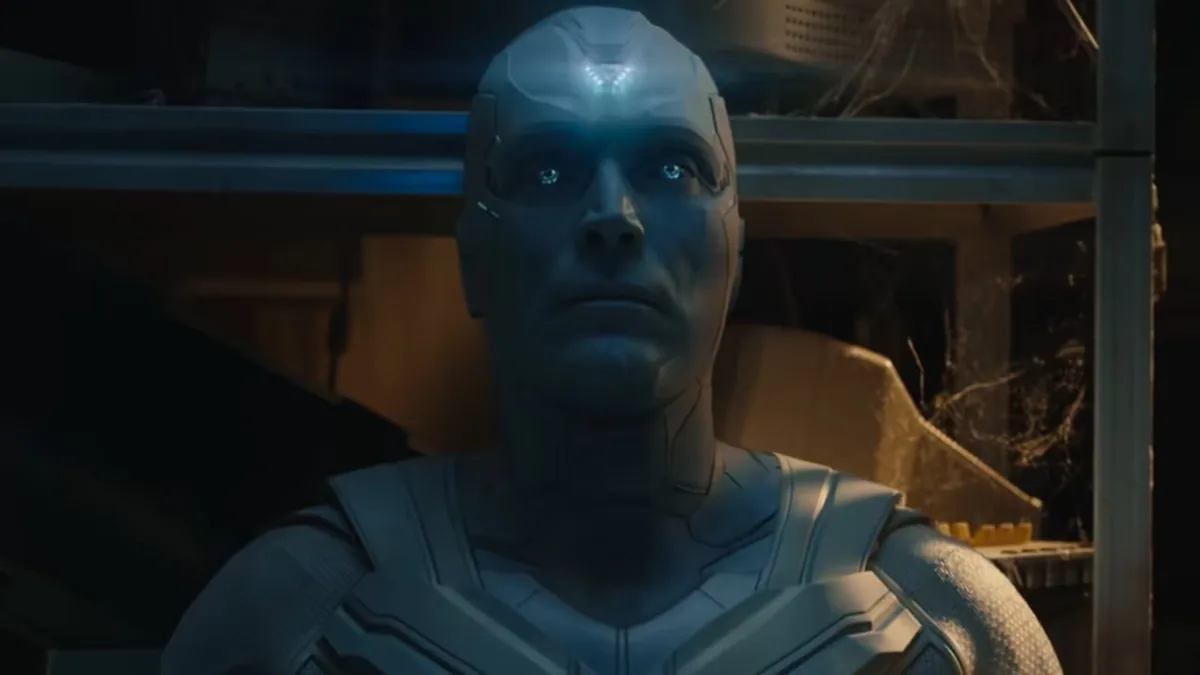
Marvel has incorporated “The Garden of Earthly Delights,” by Hieronymus Bosch into a scene from VisionQuest featuring Vision and Ultron, as Paul Bettany revealed during his visit to Málaga. The series will premiere on Disney+ Spain on Wednesday, October 14, 2026.
The link to Madrid carries a note of cinematic coincidence. Bettany spent a summer in the capital while his wife worked there and took the chance to visit the Museo del Prado, where he could view the triptych in person. Some time later he learned that Marvel’s production had brought that very work to the screen.
In an interview given to El HuffPost during the San Diego Comic-Con in Málaga, the actor explained that he did not know the painting would be used in the series when he saw it at the museum. The encounter between the two experiences struck him as especially impactful. Yet the choice of the painting is more interesting for what it implies than for the curiosity of the shoot.
Why The Garden of Earthly Delights fits with Vision’s story
The scene Bettany described pits Vision against Ultron in front of the painting. Two intelligences created from human technology stand before a work that has spent five centuries questioning impulses, contradictions, and the fate of people. It is a striking image to consider accidental within a series about memory and identity.
The National Prado Museum dates the triptych to between 1490 and 1500 and keeps it in room 056A. Its three panels show, from left to right, Paradise, a garden full of pleasures, and Hell. The institution interprets the work as a meditation on sin and the fragility of happiness that can turn into punishment.
That journey provides a counterpoint to the Marvel protagonist’s conflict. Vision retains memories of a former life, but reconstructing a biography does not necessarily mean recovering the feelings tied to it. Bettany has explained that his character wonders what humans find beautiful in a world that is disorderly and how, despite that chaos, they are capable of loving and sacrificing for others.
The reading opened by the painting is powerful: a designed intelligence seeking answers faces a painting that admits no single interpretation. It is a visual way to move the debate of the series from circuits and programming to a much more human question: are we only our memories or also the way we feel what we have lived?
Ultron’s Return Turns the Painting into Something More Than a Nod to the Prado
James Spader’s return as Ultron was already one of the major appeals of the fiction. However, the villain’s importance is not limited to bringing back a familiar foe. Ultron is tied to Vision’s origin and allows the android to confront a troubling aspect of its own existence. That approach was already evident in the VisionQuest trailer, which portrays Ultron as a personal threat.
The comparison with The Garden of Earthly Delights does not prove that Marvel intended to recreate its entire religious program or that every creature painted by Bosch hides an argumentative clue. The confirmation is the presence of the artwork and the discussion about human beauty; the rest should be read as an interpretation, not as a spoiler or a revelation about the ending.
The new series is part of the television saga begun with WandaVision. For anyone who needs a reminder of how White Vision appeared, the two preceding series that are worth revisiting before the premiere help situate the issue of his memories without having to watch all of Marvel’s films.
On October 14, Bettany’s Madrid visit will have a second life on Disney+. The appearance of a Prado work in an international blockbuster is noteworthy; its presence in a story about what it means to be human explains why it deserves attention.