
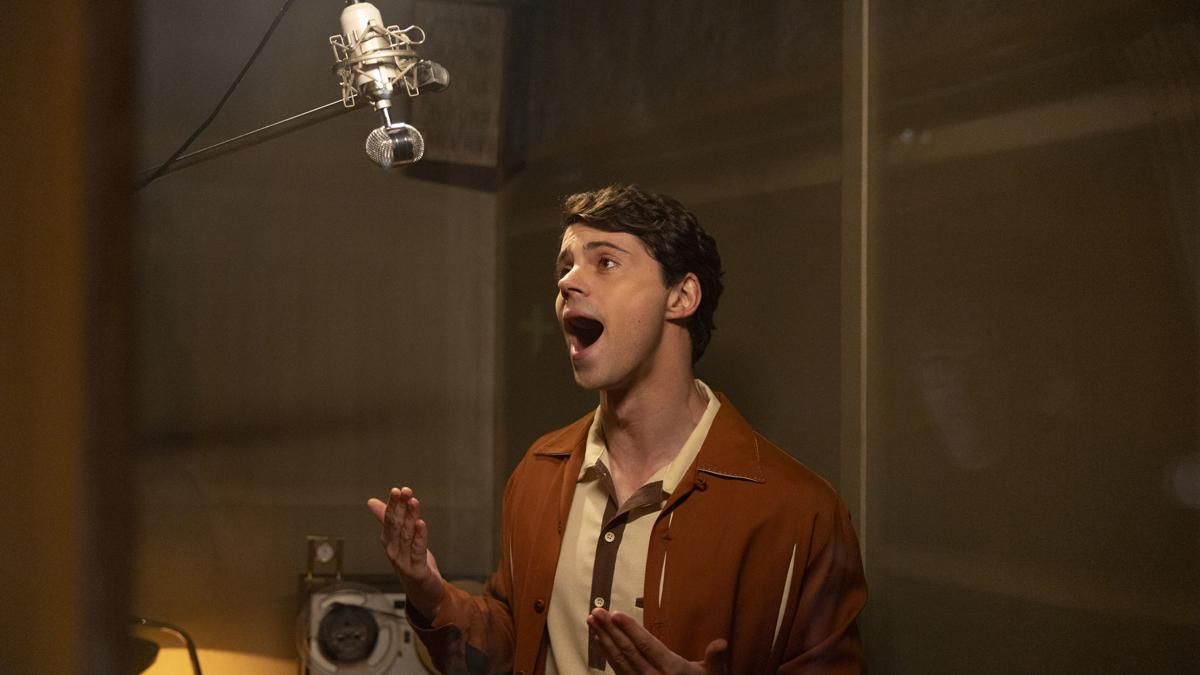
Netflix premieres this Friday, October 9, Aquel, the miniseries about Raphael, with a choice that reveals more about its approach than any recreation of a concert: two actors share the same character. Javier Morgade embodies the young singer and Carlos Santos takes on his mature self. The device allows traversing five decades, but it also forces us to answer a difficult question: how does a person become a recognizable icon even for those who have not lived through his greatest hits.
The fiction consists of eight episodes and is available in Spain and Latin America, the two markets Netflix explicitly confirmed in its presentation. It begins in postwar Spain and follows Raphael’s ascent onto international stages. That broad temporal span explains why the series cannot be limited to merely stringing together well-known songs.
Two Actors for a Single Identity
In a musical biopic, it is often debated whether the actor physically resembles the singer or reproduces his voice. Here the cast introduces another narrative challenge: what must remain recognizable when the face changes. Morgade’s younger version must sustain the momentum of someone still building a career; Santos’s Raphael represents a stage in which success has already become part of the public identity.
Continuity does not depend solely on makeup or imitation. It depends on the viewer finding a thread linking early ambition with the personal choices of maturity. The double casting, therefore, does not by itself guarantee a deeper biography, but it does reveal the main challenge for the screenwriters: to tell an evolution rather than a sequence of performances.
The production, led by DLO Producciones in association with Caracol Televisión, introduces a coherent transatlantic dimension in keeping with the artist’s career. The official announcement places the narrative across Madrid, Las Vegas, Moscow, Paris, and Acapulco; that describes the settings of the story, not proving that all those cities were used as filming locations. It is wise to distinguish the two things.
Raphael’s Story Is Also That of a Public That Has Changed
The promise of Aquel is not merely to recall a star. Raphael has traversed different generations of spectators and a music industry that scaled differently over time. Along that journey, the same song can function as a personal memory for some and as a discovery for others. That double reading is precisely the opportunity for a series that arrives now on an international platform.
The October catalog already places the Spanish viewer before a particularly broad offering, as reflected in our comparison of the premieres of the main platforms. In that context, Aquel does not compete solely as a biographical drama: it has an immediate entry point, a repertoire, and a figure that do not require presenting a fictional universe from scratch.
The presence of Jacobo Martos, the singer’s son, as associate producer and Raphael’s involvement in developing the project add closeness to family memory. They do not, however, amount to a guarantee of historical accuracy scene by scene. The television biography selects, compresses and dramatizes; a collaboration from the protagonist does not automatically turn every dialogue into a document.
That is why the interesting question of the premiere is not whether the series reproduces all the milestones of Raphael, something impossible in eight episodes. It is whether it manages to show the distance between the boy who sought to make himself heard and the public figure he became. The double casting is not a curiosity of the casting: it is the structure that will allow us to verify whether Aquel has something unique to say about the making of a legend.