
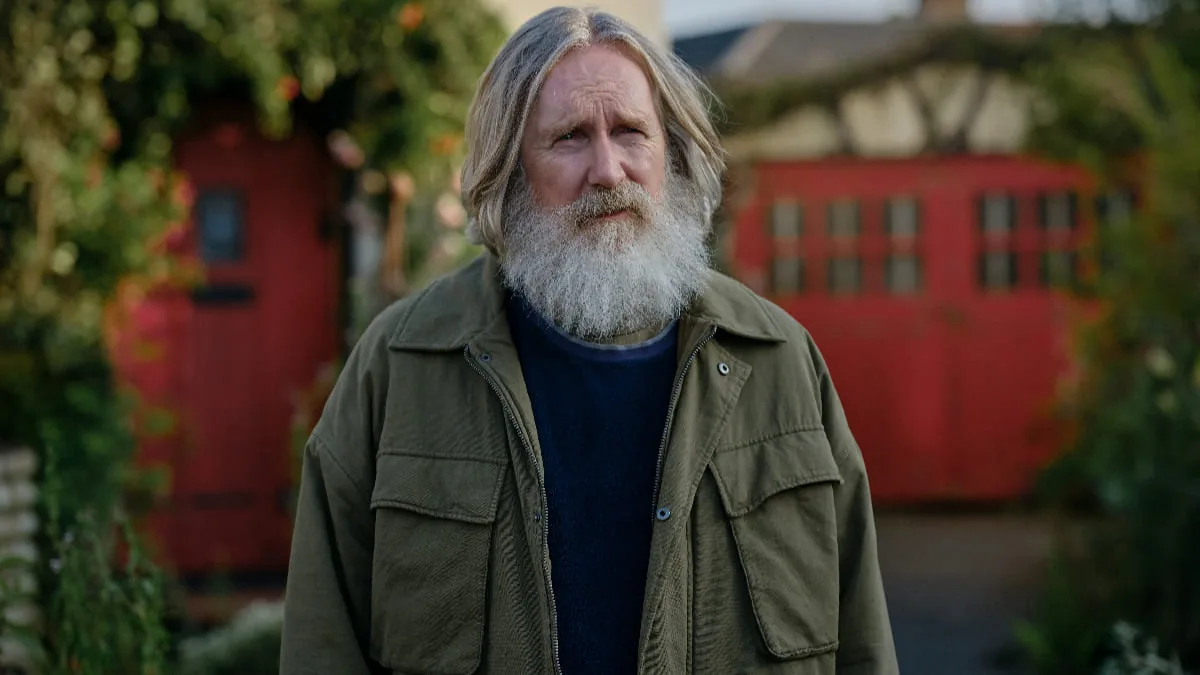
Small Prophets does not appear to be a series designed to win over everyone, and there lies much of its appeal. The fiction created by Mackenzie Crook moves between British comedy, intimate drama, and alchemical fantasy without turning any of these elements into a mere label. The result is a small, strange, and deliberately serene story about someone who has been waiting seven years for an answer.
The series, premiered on Apple TV+ on October 8, consists of six episodes of around half an hour each. Its starting point is as absurd as it is emotional: Michael tries to figure out what happened to Clea, his missing partner, following his father’s instructions to forge tiny beings capable of reading the future and always telling the truth.
A disappearance that weighs more than the mystery
The supernatural investigation is not the true engine of Small Prophets. The question of Clea’s whereabouts matters, but the series is more interested in what it means to live trapped in an absence. Michael is not a brilliant detective nor a daring adventurer who challenges the laws of nature: he is a subdued man, clinging to a routine that barely holds him up.
He works at a hardware store, where he jokes with customers and flouts his boss, Gordon, played by Crook himself. Outside that small, everyday stage, his life revolves around his father, a resident at the Golden Years Home and increasingly affected by memory loss.
The show avoids treating sadness as a solemn, permanent state. Michael can behave in petty, ridiculous, or disconcerting ways, and precisely for that reason he feels more credible. His humor does not spring from a succession of jokes, but from the discomfort of someone who does not know how to move forward and uses irony to avoid facing what hurts.
Fantasy slips in through the back door
The fantastical element appears without ceremony. There is no fully explained mythology or a war between magical forces. There is a recipe, some chants, a blend of ingredients, and the possibility of raising homunculi in the garden. The fiction accepts that premise naturally and allows the impossible to coexist with elderly residences, neighborhood shops, and family squabbles.
That tone is decisive. Small Prophets does not use alchemy to escape reality, but to look at it from a different angle. The homunculi may offer answers about the future, but they do not automatically resolve grief or erase years of waiting. Their existence raises a more uncomfortable question: what would a person do with the truth if they have spent too long building their life around not having it?
The series also finds poetry in details that might seem casual: a meteorite falling in the right place or an oil stain shaped like a rabbit. They are images that broaden the world without turning it into a catalog of oddities. In this story, the extraordinary does not need to be underscored to matter.
The homunculi are far more than a visual lure
The major risk of such a proposal was that its creatures would end up as a mere promotional curiosity. The production avoids that problem by weaving them into Michael’s emotional conflict. The homunculi have a striking design, but their function is not limited to evoking tenderness or strangeness: they are the bridge between the protagonist’s obsession and the need for answers.
Their appearance blends stop-motion animation and digital effects, with work by McKinnon and Saunders and the participation of animators Ainslie Henderson and Will Anderson, both BAFTA-nominated. The result preserves an artisanal texture that suits the show’s personality better than a creature created purely through digital effects.
The visual choice also has narrative consequences. Seeing those tiny beings float in the water makes tangible an idea that might otherwise stay abstract: Michael is trying to manufacture answers with his own hands. The alchemical process is, at heart, an extreme form of refusing to accept that he may never obtain the closure he seeks.
A cast that understands the tone
Pearce Quigley sustains the series with restraint. His Michael does not need grand speeches to convey exhaustion; it is enough to observe how he relates to his surroundings, how he avoids meaningful conversations, or how he turns a ridiculous gesture into emotional defense.
Opposite him, Michael Palin brings to the father a mix of charm, disorder, and fragility. His eccentric stories could function as a source of humor, but the gradual loss of memory introduces a sadness that changes every exchange between them. The series understands that a person can be funny and painful at the same time, without one dimension invalidating the other.
Crook, also known for his work as an actor, writer, and producer on titles like Detectorists or Britannia, returns to rely on imperfect, recognizable characters. He does not aim for the viewer to admire Michael, but to understand why he has remained stuck at that point in his life.
A comedy with a peculiar rhythm
It is worth adjusting expectations. Small Prophets is not a comedy of constant laughter nor a fantasy adventure with an expansive mythology. Its humor depends on silences, awkwardness, and the relationship between characters who often seem to be talking about different things.
That rhythm can feel uneven, especially when the story lingers on everyday situations and hardly progresses in the search for Clea. Yet the brevity of the episodes works in its favor: the series does not need to turn every episode into a major event and can afford to cultivate atmosphere, routine, and small shifts in its protagonists.
There is also an interesting decision in how the mystery is approached. The disappearance functions as a narrative promise, but the interest does not depend solely on discovering what happened. The series wants the viewer to accompany Michael as he decides whether waiting is a way to keep love alive or a means of indefinitely postponing his own life.
A rarity with room to grow
The first season leaves room to continue the story, and the series has already been renewed for a second installment. That future could be an opportunity to delve deeper into the rules of the homunculi, but also a challenge: the more the alchemy is explained, the greater the risk of losing the mysterious lightness that makes the concept special.
For now, Small Prophets works best as a portrait of a stubborn sadness rather than as a fantastical tale. Its creatures are memorable, its staging has personality, and its cast makes the eccentric premise feel human at its core. It is not a perfect series, nor does it pretend to be; it is one of those productions that asks for patience until its blend of oddity and melancholy finds its own rhythm.
Its greatest virtue lies in understanding that magic does not always help to change the world. Sometimes it only offers a different way to stay in it while the long-awaited answer arrives, or perhaps never arrives.