
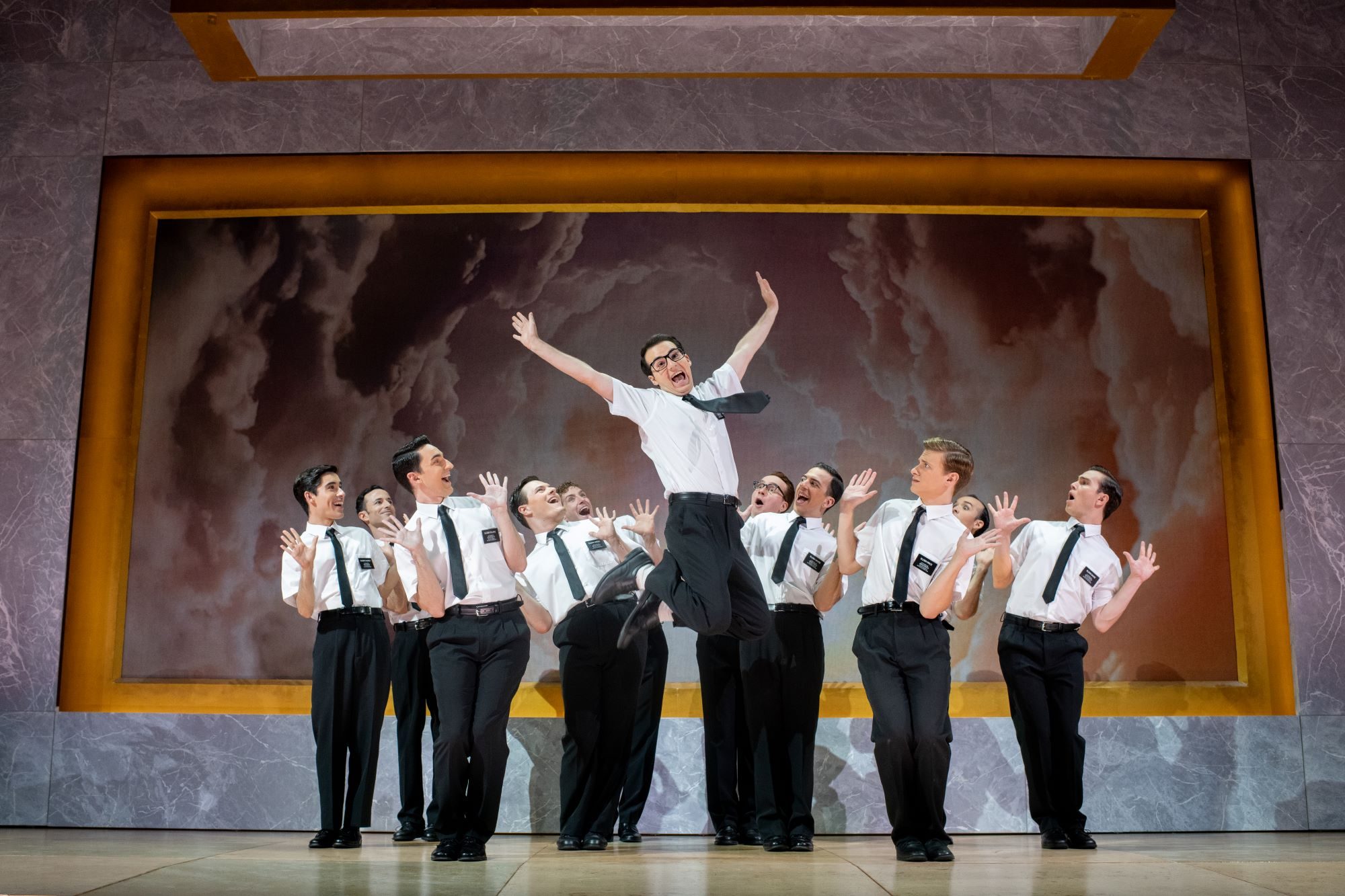
Over 600,000 spectators in Madrid, three consecutive seasons, and performances almost sold out for years. At first glance, The Book of Mormon is one of the greatest recent successes in musical theater in Spain.
But that fact, in reality, does not merely explain the phenomenon. It explains the system.
Because when a production reaches that level of stability for so long, it stops being a one-off. It becomes a pattern. And that pattern is what defines today the musical theater scene in Madrid.
Success doesn’t start in Madrid
There is a key detail that is often left out of the conversation: The Book of Mormon didn’t originate here.
Before arriving in Spain, it had already spent more than a decade thriving on Broadway and the West End, with awards, international recognition, and a solid audience. In other words, when it lands on Gran Via, it arrives with something very few productions can afford: zero uncertainty.
It isn’t about testing whether it will work. It’s about replicating something that has already worked.
That nuance changes everything.
Madrid as a landing point, not a starting point
In recent years, Madrid has grown to become one of the major hubs of musical theater in Europe. The numbers of productions and audiences back this up.
Yet, that growth has a very specific characteristic: it is not based on creating new musicals, but on adapting international hits.
The trajectory of The Book of Mormon illustrates this perfectly:
First it works abroad.
Then it is adapted.
Then it runs for several seasons.
And finally it withdraws.
Not because interest fades, but because the system needs another title to come in.
When success doesn’t decide the end
Here comes one of the most interesting points.
In traditional theater, a play typically stays on the bill as long as it works. In musical theater, that is happening less and less. Shows that keep filling houses can leave simply because there is another big bet waiting for its space.
This turns the lineup into something closer to strategic programming than to a direct response to demand.
The logic is different: it isn’t about how long a hit lasts, but when it’s time to replace it.
Minimizing risk, the absolute priority
Musical theater is one of the most financially demanding formats: large casts, complex sets, extensive technical crews, and months of preparation.
In that context, backing an original work means taking on a high risk.
The sector’s solution has been clear: bet on products that have already proven themselves.
There are titles like The Book of Mormon, which arrive with a prior track record that minimizes uncertainty. It’s not just a show. It’s a controlled investment.
And that explains why this kind of production dominates the bill.
The paradox of growth
The result is a thriving sector, but with a very concrete base.
Madrid has more musicals than ever.
More audience than a few years ago.
More international relevance.
But at the same time, fewer projects are starting from zero within the local market.
Growth exists, but it does not necessarily imply greater creative diversity.
And that is the part that often remains outside the narrative.
A model that increasingly resembles streaming
Viewed from afar, the parallel is evident.
Like platforms, musical theater bets on recognizable titles.
Like the film industry, it prioritizes franchises over creative risk.
Like television, it organizes its offering based on rotation and strategy.
The difference is that here everything happens live.
But the logic is the same.
What this case reveals
The journey of The Book of Mormon speaks not only of a single success.
It speaks of a sector that has found an effective formula: import, adapt, exploit, and renew.
It works.
The figures back it up.
But it also raises a question that is becoming inevitable:
How far can an industry grow if its main engine is not creation… but choosing what to import?
The answer, for now, continues to fill theaters.