
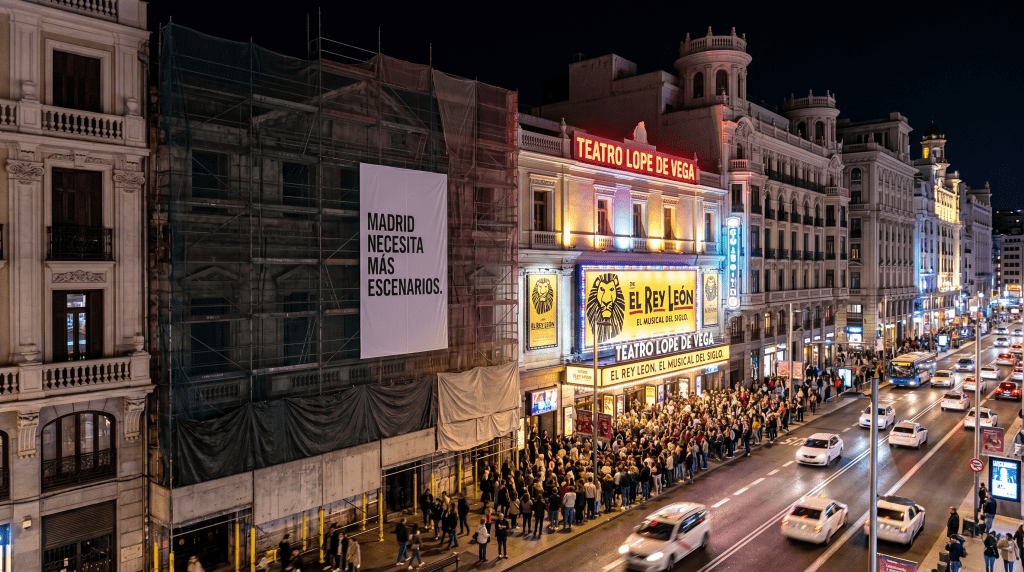
Madrid is living a fever for musicals that is visible from the sidewalk: lit marquees, long queues, free tickets, tourists with dinner reservations, and families who have already turned Gran Via into a tradition. But the important story isn’t just in the posters. It’s in the buildings.
The clearest sign has arrived with a business move that may seem cold, but explains a lot: Stage Entertainment has acquired 100% ownership of the Lope de Vega Theatre and the Ocaso Coliseum Theatre, two of Madrid’s most emblematic musical venues. The company itself notes that they are the only theaters in central Madrid with more than 1,400 seats each, a scale essential to hosting mega-productions like The Lion King or other long-running titles.
The question is no longer only which musical arrives in Madrid. The question is where it fits. And, above all, who controls that “where.”
The news isn’t just a purchase: it’s control of the board
Stage Entertainment’s press release has an evident reading: the company reinforces its bet on Madrid. But the more interesting reading is another one. In a market where every major musical needs months of performances, complex technical setups, large crews, advance ticketing, and long amortization, owning the theater is not a real estate detail: it is a competitive advantage.
Lope de Vega and Ocaso Coliseum add up to about 3,000 seats and are located on Gran Via, the symbolic and commercial axis of Madrid’s musical scene. Stage asserts that the deal gives it “total operational control” and more flexibility to invest both in productions and in the public experience. It also points to an ambitious figure: together with its third venue, it could host around 1.5 million spectators per year.
That third space is another key piece. The company is working on transforming the former IMAX cinema at Enrique Tierno Galván Park into the Stage Grand Musical Theatre, with an opening planned for fall 2027. It won’t be on Gran Via, and that already opens another reading: if Madrid wants to keep growing as a musical city, perhaps the center alone isn’t enough. It needs to create new central hubs for performances.
Big musicals don’t get programmed just anywhere
Madrid’s lineup shows that musical theater is no longer a homogeneous block. Long-running brands, limited runs, family titles, adult-oriented proposals, international classics, and mid-format musicals coexist. Madrid boasts a program with titles such as Les Misérables, Wicked, The Book of Mormon, SIX, The Sound of Music, Don’t Touch the Story, or Dad’s High Heels, distributed across theatres like Apollo, Nuevo Teatro Alcalá, Rialto, Gran Vía, Alcázar, Pavón or Lara.
But not all of those titles play in the same physical league. A small musical can live in a flexible room, a lighter production, or a fragmented calendar. A mega-production needs something else: sufficient capacity, a prepared stage, loading and unloading, dressing rooms, a pit or musical solution, prolonged availability, and a location that allows selling the experience before and after the show.
There lies the silent war. It isn’t fought with headlines, but with contracts, renovations, calendars, and rights. A theater filled by a long-running hit is a blessing for its operator, but it also blocks the entry of other projects. A large, free space can decide an entire season. A renovated venue can change the type of musical a city is capable of hosting.
That’s why the growth of musicals in Madrid doesn’t depend only on the audience. It also depends on something less glamorous: how many stages can truly sustain an ambitious production.
Madrid has a lineup, but also a bottleneck
The phrase “Madrid, capital of musical theater” works well in promotion, but it risks concealing an obvious tension. To sustain that label, it’s not enough to have many titles. An enduring infrastructure is needed that can blend three speeds: long-running shows, seasonal premieres, and high-risk projects.
Having full ownership of Lope de Vega and Coliseum allows Stage to organize its strategy with greater margin. It can decide on investments, calendars, and the use of the theater without depending on the same type of negotiation that a producer who rents or seeks space would. That doesn’t mean the market is closed, but the board becomes more asymmetric: whoever controls large theaters controls part of the capacity to dream big.
For spectators, this translates into something concrete. The lineup they see is not only the result of demand but of availability. Some musicals don’t arrive because there isn’t an audience, but because there isn’t an appropriate venue, or because the right venue is occupied, or because the risk of moving a large-format production isn’t outweighed by a sufficient exploitation window.
Madrid’s case also has a peculiarity: its strength is highly concentrated in a zone of extreme symbolic and commercial value. Gran Via sells more than a show. It sells strolling, dining, hotels, photos, and a complete plan. Moving the musical away from the center requires creating a new habit. There the future Stage Grand Musical Theatre will prove interesting: if a major production can generate a destination beyond the usual postcard, Madrid will have expanded its map. If not, Gran Via will remain both queen and bottleneck at once.
The next battle will be for space, not for the slogan
Madrid’s musical scene has entered a more mature phase. It’s no longer enough to import international hits or celebrate every premiere as a conquest. The sector is beginning to look like an industry with strategic assets, corporate concentration, technical specialization, and a need for multi-year planning.
That can bring advantages. More investment tends to bring better productions, more stability, greater professionalism, and a more carefully curated audience experience. But it also raises uncomfortable questions: how much room remains for mid-sized producers, how many theatres can compete for major licenses, what space do original Spanish-language musicals have, and whether the concentration of venues can constrain the real diversity of the lineup.
This story connects to a broader discussion about the model of theater for musicals in Spain. The success of titles like The Book of Mormon, already analyzed as a symptom of a system that reduces risk by leaning on proven brands, helps explain why controlling venues is so important: when a city bets on large musicals, it needs certainties before lifting the curtain.
Madrid wants to be the capital of musical theater. In fact, to a large extent it already is for Spanish-speaking audiences. But the next stage will not be decided by flashy campaigns or new posters alone. It will be decided by a less romantic and much more decisive question: who holds the keys to the theaters where large dreams fit.
The Keys
- Main fact: Stage Entertainment has purchased the entirety of the Lope de Vega Theatre and the Ocaso Coliseum, two key Madrid musical venues.
- Why it matters: Large musicals depend not only on the public but on theaters with capacity, technical capability, location, and availability.
- What this piece adds: It looks at the lineup from the infrastructure angle, not from premieres, and explains why venues are an industrial lever.
- What could happen next: The future Stage Grand Musical Theatre will test whether Madrid can broaden its musical map beyond Gran Via.