
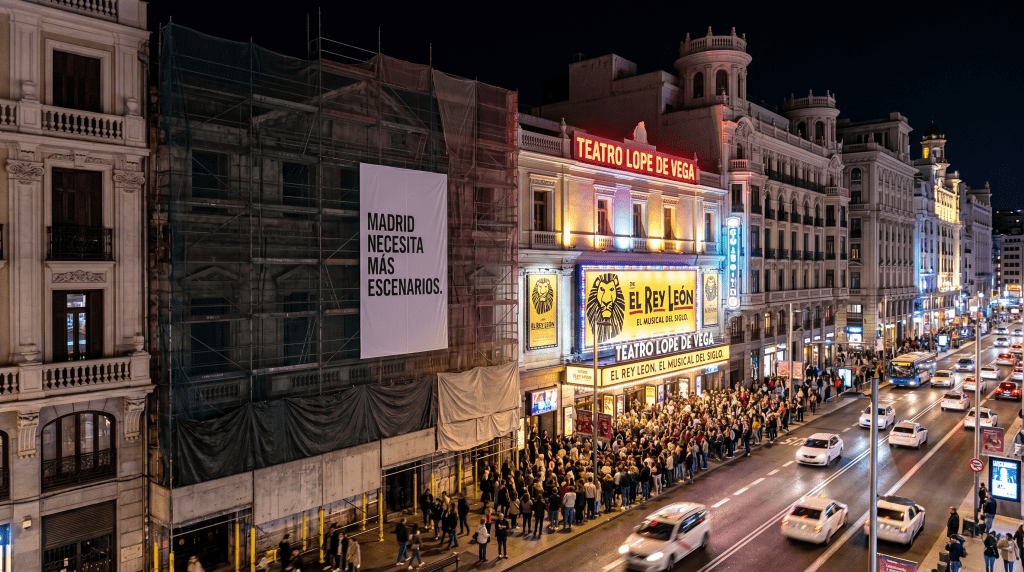
Madrid will kick off September with a lineup capable of sustaining a comparison that not long ago would have seemed exaggerated. Eight major musicals will coincide during the peak autumn period, thousands of seats will go on sale each week, and several of the leading international companies in the field already have direct stakes in the city. Madrid has learned to produce musicals on a large scale. Creating them, however, is another matter.
Just look at the names of the new season. The Lion King, Les Misérables, SIX, The Addams Family, Wicked, We Will Rock You and Dear Evan Hansen share something beyond their budgets: all seven originate from musicals, characters, catalogs or intellectual properties developed outside Spain. The eighth major title of that autumn lineup breaks the pattern. El alma al aire, built from the songs of Alejandro Sanz, will have its world premiere in Madrid on October 1.
This is not a minor difference. The capital has shown that it can adapt Broadway and the West End, assemble competitive casts, fill venues, and turn an admission into a tourist product. The next business is to ensure that one day the reverse journey happens: that a story developed in Madrid becomes the one bought by London, Hamburg, Mexico City or New York.
Madrid has learned to import on a large scale
The upcoming season poses a real stress test for the growth of Madrid’s musicals. Across several October days, eight major productions will be selling tickets simultaneously, though not all will offer performances every night.
The scale achieved explains why importing big titles makes sense. The creative risk has already been tested in another market. Wicked does not need to prove there is an audience for its story. Les Misérables has been doing so for four decades. SIX arrives with an existing international community, and The Lion King has turned precisely that combination of global brand and local execution into an exceptionally resilient machine.
Stage Entertainment offers a gauge of the size acquired by that model. The company says it has drawn 20 million spectators to its musicals in Spain and currently sells more than one million tickets per year. Only The Lion King has surpassed seven million spectators since its arrival in Madrid in 2011.
Importing, moreover, does not mean copying. Adapting one of these shows requires translation, casting, musicians, technicians, workshops, marketing and, depending on the title, recreating very precise creative standards. Spain has developed all of that professional fabric. But the original asset, the musical that can be licensed repeatedly to other territories, has typically been conceived abroad.
El alma al aire changes one important word: developing
That is why it is especially revealing how Stage presents its main autumn novelty. The company defines El alma al aire as “the first project developed entirely in our country” in its Spanish history. It will have a librettist, Álvaro Tato, songs by Alejandro Sanz, and its world premiere at the Teatro Ocaso Coliseum.
The company that has built much of its business by bringing titles born in other markets to Spain is now testing what happens when it participates from the origin.
That changes the nature of the risk. With an international license there is already a track record of audiences, critics and staging. Creating a musical means investing before knowing if the product exists. One must develop a script, test materials, build dramaturgy around the songs, organize workshops, and discover during the process whether what works on paper can sustain two hours in front of an audience.
It also changes the potential reward. If a title with international reach is created, its commercial life can continue long after leaving the theatre where it was born. Productions, adaptations and licenses in other territories turn the creation into an asset capable of traveling.
El alma al aire is, of course, not starting from zero. Alejandro Sanz brings one of the most recognizable catalogs in Spanish. That advantage precisely explains why the experiment is interesting: Stage is reducing part of the commercial risk while taking on for the first time the risk of developing the full theater structure here.
Spain already has evidence that the reverse journey is possible
It would be unfair to present Spanish creation as a blank territory. There is another part of the industry that has been trying for some time to build its own repertoire.
Iván Macías and Félix Amador are perhaps the most obvious example. After developing in Spain projects such as El médico, El tiempo entre costuras, or Los pilares de la tierra, the two creators have now taken a deliberately international step. This August, news of their involvement in Impulse Scena, a platform seeking to connect European and American production, emerged. Their project Carmen, a New York Story will have its first stop in Brno before continuing development with New York on the horizon.
It is a small signal compared to the volume of imports, but important. Exporting a musical does not necessarily require having also created the novel, character or story that inspires it. The business may lie in owning and developing the theatrical adaptation, the music, the libretto, and the production model that later travels.
Here lies a particularly interesting opportunity for Spain. The country has authors, musical catalogs, novels, films and characters recognizable worldwide. It already has teams capable of mounting mega-productions. What still does not exist on a comparable scale is a continuous slate of musicals born here that could become international products.
Being the capital of the musical should also mean producing musicals
The 2026-2027 season demonstrates that the Madrid market has moved beyond an initial stage. It no longer needs to convince anyone that there is an audience. The discussion now centers on how much it can grow, which productions will survive an increasingly competitive lineup, and which companies will end up concentrating the market.
But that very maturity allows posing a more ambitious question.
Broadway and the West End are global references not only because they house theatres or attract tourists. They are also because they function as factories of theatrical intellectual property. Shows are developed there, tested, fail or triumph, and when one with international potential appears, another part of the business begins.
Madrid has learned, with considerable success, the final stretch of that chain. It receives titles, adapts them into Spanish, and manages to keep some of them for years. Now it must prove whether it can master the first part as well.
Whether El alma al aire works or not will, of course, be the first question for any producer when performances begin. But there is another question that will take much longer to answer: whether within five years we will see that musical born at the Ocaso Coliseum advertised on a marquee outside Spain.
If that starts to occur regularly, Madrid could add a much more valuable word to its status as the capital of the musical: exporter.