
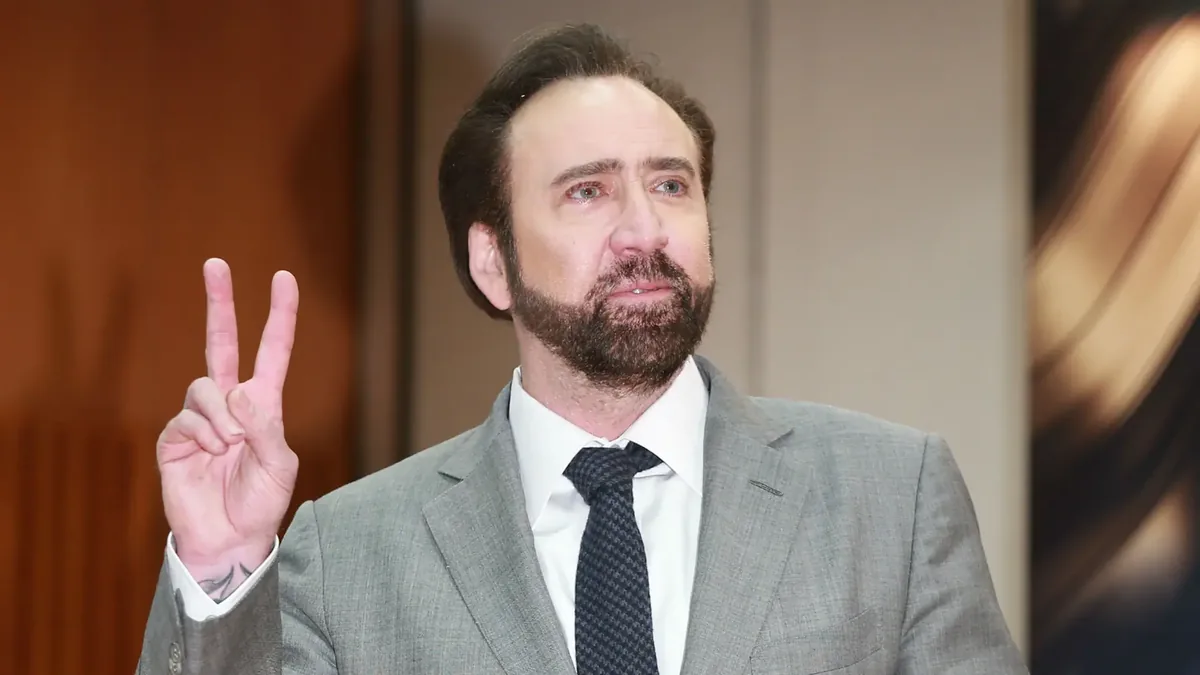
Nicolas Cage has weighed in again on superhero cinema and this time his jab lands squarely at the Marvel Cinematic Universe. During a panel at Fan Expo Dallas, the actor praised the franchise’s early era, but questioned its more recent evolution by comparing it to a high-budget version of WWE.
The remark has drawn particular attention because Cage knows the genre from the inside. Before the MCU’s consolidation he starred in Ghost Rider, lent his voice to an alternate version of Spider-Man in Spider-Man: Into the Spider-Verse, and has played characters tied to the web-slinger in other projects. His critique, therefore, does not come from someone detached from superhero spectacle.
What Nicolas Cage has said about Marvel
The actor’s intervention began with a clear recognition of the MCU’s early films. Cage highlighted how those stories connected the origins of their characters and built a shared narrative, one of the project’s main hallmarks from Marvel Studios.
He then turned his attention to the current phase. His comparison was blunt: he described the outcome as a “glorified and big-budget WWE”.
The actor added an important caveat: he said he was speaking “with affection.” He wasn’t denying the talent of the performers nor claiming that every film works the same way. His remark points more to a sense of weariness tied to the repetition of a visual and narrative formula that had seemed novel for years.
The WWE comparison is not limited to the costumes
The reference to American professional wrestling works because it condenses several characteristics of the contemporary blockbuster. In both cases there is a strong spectacle dimension, recognizable characters, matchups designed to provoke an immediate reaction, and a staging where visual identity weighs as much as the story.
In the MCU, costumes are not a secondary detail. They help distinguish the heroes, condense their personalities and allow transferring to the cinema elements drawn from the comics. The problem Cage raises is another: when the outfit, the armor, or the digital transformation becomes the main lure, the character can be subordinated to the machinery of spectacle.
The comparison also touches on an age-related issue. Superhero cinema has turned veteran actors into action figures, often through training, stunt doubles, visual effects and rejuvenation technology. That evolution has broadened the genre’s possibilities, but has also intensified the feeling that any performer can be brought into a franchise if the studio finds a way to integrate them into the visual machine.
The weariness of Marvel’s model
The MCU is no longer at the same cultural moment as during its first great phase. The incremental construction of the Avengers offered audiences an easily followable through-line: each film could work on its own, but it also formed part of a larger project with recognizable goals.
As the franchise grew, that architecture became more sprawling and harder to grasp. Films, series and new offshoots broadened the universe, but also raised the effort required to stay up to date. For some audiences, the promise of connection stopped being a lure and began to feel like an obligation.
That is where Cage’s observation fits. His critique isn’t limited to there being more superheroes or more battles; it’s that the model can lose impact when viewers perceive that every installment must set up another story, present a new threat, or bring back a familiar character. The spectacle remains, but the element of surprise is no longer guaranteed.
Nicolas Cage is also part of that tradition
The irony of his words is evident. Cage played Johnny Blaze in the two Ghost Rider films, released before Marvel Studios launched its shared universe. Those productions belonged to a different era of comic-book cinema, when studios were still exploring very different formulas to bring the characters to the screen.
His link to Marvel also passes through Spider-Man. The actor lent his voice to Spider-Man Noir in Spider-Man: Into the Spider-Verse, an intentionally exaggerated and stylized version of the character. The film used animation to play with different aesthetics, tones and variants of the hero, precisely the kind of formal freedom that allows the genre to escape uniformity.
That’s why his statements carry an additional reading. Cage isn’t rejecting comics or superhero fantasy; in fact, his career shows the opposite. What he seems to question is the tendency to turn any story into an interchangeable piece of a much larger brand.
A critique of the spectacle, not a definitive verdict
The actor’s words shouldn’t be read as a definitive diagnosis about Marvel’s future. The MCU remains one of the most recognizable franchises in audiovisual entertainment and retains an extraordinary ability to attract attention, assemble major casts, and turn its releases into global events.
The WWE comparison works precisely because it’s easy to understand, but it also simplifies a broader reality. Marvel’s universe blends melodrama, comedy, science fiction, horror, adventure, and action. Some productions aim for pure spectacle; others seek to explore more intimate conflicts or less conventional visual styles.
The interesting debate is whether the franchise can still make those differences matter. After years of expansion, the challenge isn’t just about introducing new heroes or increasing the scale of battles. Marvel needs the audience to feel again that behind the costume there is a character, and behind the event there is a story worth telling.
Cage has fired a barb from a peculiar position: that of an actor who has participated in the superhero imaginary but never fully integrated into the MCU’s core. His remark can be taken as a provocation, though also as a useful warning: when the costume and the scale of the spectacle weigh more than the film’s identity, even a gigantic franchise runs the risk of seeming like a repetition of itself.