
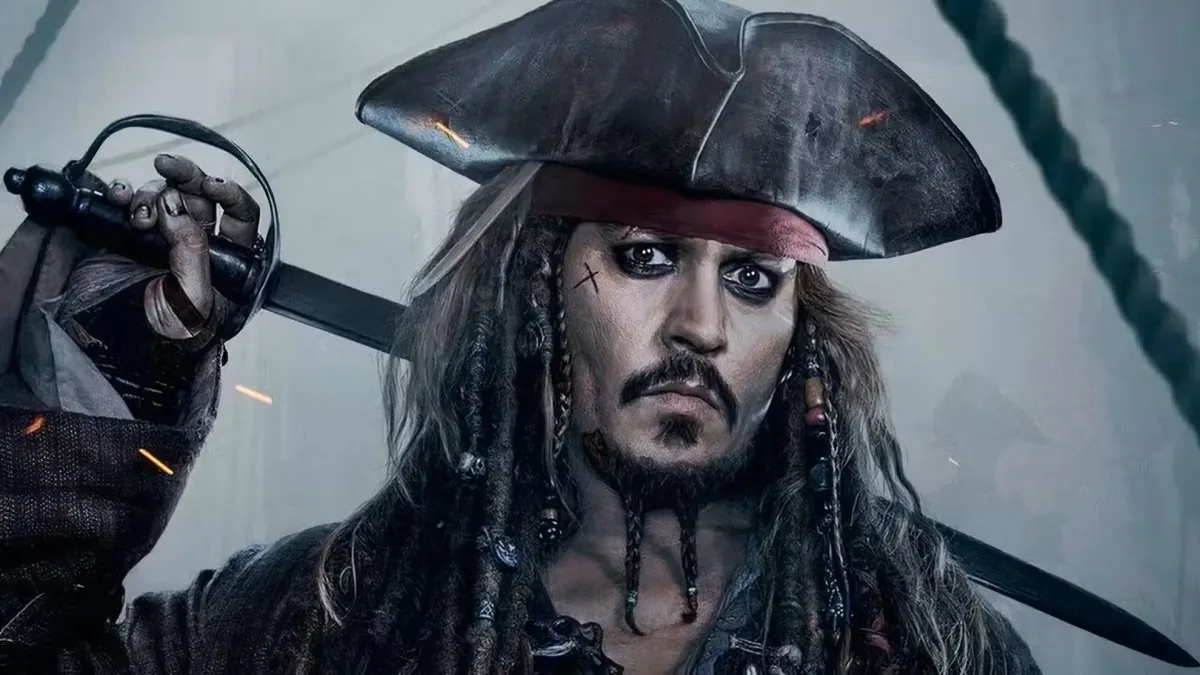
Long before Jack Sparrow became one of the most recognizable characters in mainstream cinema, Johnny Depp conceived him with a memorable trait: a blue nose. The idea emerged during his first meeting with director Gore Verbinski, as they discussed how to craft the protagonist of Pirates of the Caribbean: The Curse of the Black Pearl.
The idea had an in-fiction explanation. Sparrow would have lost his nose during a swordfight and it would have been sewn back on. As a result of that procedure, Depp imagined the area would have poor blood circulation and take on a bluish tint. The character would also be more afraid of pepper or catching a cold than of dying.
The idea that stayed out of the film
The anecdote is known thanks to the audio commentary by Johnny Depp and Gore Verbinski included in the home release of the first film. During that conversation, they recall the moment when the actor explained his initial vision for the pirate and how that meeting evolved.
According to the account shared in the commentary, Verbinski initially assumed they should take the star’s proposal seriously. The director even considered how to defend it to Disney, until Depp realized the idea was too far-fetched to push forward and told him it would not be necessary.
The blue nose, therefore, did not become part of Jack Sparrow’s final design. It also did not become a recurring element of the saga: it remained a discarded possibility during the character’s development.
From a Disney attraction to a pirate with his own identity
The movie’s context helps explain the significance of that phase of work. Pirates of the Caribbean: The Curse of the Black Pearl was born inspired by the eponymous attraction at Disney parks, a starting point that required turning an experience based on sets, figures, and spectacle into a cinematic story with characters capable of sustaining a franchise.
The film had to work as a pirate adventure accessible to a broad audience, but it also needed a central figure with enough personality not to be reduced to another action hero. Depp’s contribution occurred precisely in that area: he did not limit himself to playing a conventional captain, but proposed a very specific way of understanding his behavior, his physique, and his sense of humor.
The blue nose was part of that search, although the audio commentary does not present it as a definitive decision nor as a trait the studio would formally value. It was an idea expressed in a creative and exploratory conversation that was abandoned before becoming a production requirement.
What ended up defining Jack Sparrow
The Jack Sparrow who screen audiences met retained a striking appearance, but not that physical transformation. The makeup, wardrobe, braided hair, accessories, and the way he moved all contributed to a recognizable visual identity without needing to add a blue nose.
What the audio commentary documents allows us to separate two things. First, the fact: Depp did raise that possibility and then discarded it. Second, the interpretation: it is reasonable to read the anecdote as evidence that the actor was seeking a character far from the solemn pirate, but the commentary does not prove that every subsequent Sparrow trait sprang directly from that proposal.
That nuance matters because the story has over time become one of those anecdotes that seem to summarize a creative process on its own. Yet what the material confirms is something more concrete: during the film’s preparation, Depp tested an extreme idea, Verbinski weighed how to respond to it, and both understood that it should not progress beyond a conversation.
A small decision within a decisive film
Discarding the blue nose does not mean the performance lost its individuality. On the contrary, the final result made Sparrow a character recognizable through a combination of gestures, rhythm, voice, and appearance, not through a single extravagant detail.
The choice also prevented a visually striking trait from competing with the rest of the elements the film needed to balance: fantasy adventure, humor, action, and the relationship among Will Turner, Elizabeth Swann, and Jack Sparrow. It cannot be claimed that the blue nose would have necessarily changed the film’s reception, but it would have added a striking aesthetic decision that would have been hard to ignore.
The result was strong enough for Depp to receive an Oscar nomination for his performance in the first installment. The franchise went on to new adventures, but the Sparrow the audience identified was fixed in that first movie, without the blue nose that his performer had momentarily imagined.
The anecdote reveals how icons are built
The story does not prove that a franchise is built from isolated ideas, but it does illustrate the margin of exploration that can exist before a character finds his definitive form. In a production tied to a brand as recognizable as Disney, even an apparently impossible proposal could help delineate what tone fit and which one wandered too far from the whole.
Jack Sparrow did not need a blue nose to differentiate himself from other cinematic pirates. The idea faded during the conversation phase, while the interpretation that eventually reached theaters became the element that completely changed the identity of Pirates of the Caribbean.